With all the rains and people not able to get out of their houses, Karkitakam (or Aadi) ends up being a month full of many religious activities. As I said earlier, there are regular Ramayanam recitals and also Pujas for the Bhagavathi . Apart from this, most Kerala Iyer families perform Bhagavati Seva during Karkitakam, which is believed to be the highest form of worshipping Devi. The other festivals during Karkitakam are Aadi Amavasya (new moon day of the month of Karkitakam), Aadi Krithikai and Aadi Pooram, and Pathinettam Perukku.
Although pithru tharpanam is performed for our deceased ancestors on all new moon days, Aadi Amavasya is specially observed as the day for paying obeisance to the ancestors and taking their blessings. In Kerala especially, Vavu Bali or Vavubali Tharpanam is an important ritual in the month of Karkitakam. Though in the Kerala Iyer community only men perform the tharpanam, among the native Kerala Hindus both men and women participate in offering bali or tharpanam to the ancestors. Usually, it is performed at river banks or beaches or wherever there is a water body. Many people make a special visit to the important religious places like Thirunelli, Thirunavaya, Aluva, etc., to offer bali on Karkitaka Amavasya.
In Karnataka, Aashada Amavasya is observed as Bhimana Amavasya. On this day, married women worship for the well being of their husbands. I am told they even do Padapuja to their husbands. Aadi Krithikai is an important festival in the Lord Subramanya temples, which is celebrated on the day of the Krithika star in the month of Karkitakam. Aadi Pooram is celebrated in all the Devi temples and is believed to be the birthday of Devi. Pathinettam Perukku is the 18th day in the month of Aadi or Karkitakam and is a big festival day in Tamil Nadu, especially in the Cauvery Delta region. By the 18th of the month, there would have been heavy rains and the rivers would be overflowing the banks. People go out on picnic to the river banks and offer Pooja to Cauvery and enjoy the day with friends and relatives. In Kerala though, Iyers never took a picnic out, but had an elaborate lunch at home. As children, we used to write the Malayalam Aksharamala (alphabet) and sailed it in the overflowing water on this day. I don’t remember the significance of this. However, this is not celebrated in Karnataka, where the Cauvery originates.
Aadi Velli or the Fridays in the month of Karkitakam are especially dedicated to propitiate Devi Bhagavati. Special poojas are performed at home by the women folk. We used to have a Maa Vilakku or Pachai pooja on the Friday of the Karkitakam. Different families conducted this pooja on different Fridays. As it was not performed by my mother-in-law, I am not very sure of the rituals. I only remember that we used to decorate the pooja room with rangoli and neem leaves and red hibiscus flowers. Rice was pounded to fine powder and again pounded with jaggery to make sticky dough. Little lamps were made out of this dough into which ghee was added, the wick inserted and the lamps were lit. My echiyamma said some special prayers and offered the maavu (sweet dough) to Devi. Later this maavu was distributed among all the other ladies of the neighbor hood. This dough was very tasty, especially the portion in which the wick was lit (to us children who were unspoilt by candy, icecream and other junk food)
I remember an interesting anecdote about this Maa vilakku Pooja. This happened when I was perhaps 7 or 8 years of age. There was this Maa vilakku pooja in one of the neighbouring houses and they had sent the maavu home. My aunt was distributing the maavu to all children. My younger brother, who was 4 and my cousin who was 3 were not happy with the portion they got. They asked for more. My aunt said that it was all over. When these two kids insisted for having more, my aunt said, “You have to go to Sethuppa’s house, if you want more.” That was the house which was performing that pooja on that day. After sometime when we could not see the kids around, we started looking for them in the neighbourhood. Where should they be, but at Sethuppa’s house. Both were coming out with beaming faces and full of maavu in their hands. Sethumma (Sethuppa’s wife) said, “When I came out, I saw these two kids standing on our front steps. I asked them to come inside and enquired what they wanted. They said, ‘We wanted more maavu and amma said if we wanted more maavu we have to go to Sethuppa’s house. That’s why we are here.’” Sethumma was so overcome with joy that two kids should come to their house asking for maavu, she filled their hands with maavu and sent them home. Seeing the kids’ happy faces we all burst out laughing.
Thursday, August 07, 2008


Monday, July 21, 2008
Aaniyum Aadiyum story
To celebrate the onset of Aani and Aadi, I have posted a story that my mother in law used to tell my children on the stories website, Kathai Kathaiyam Karanamam.
My handsome and charming son has also added a section on the sidebar to the right that keeps up to date with the latest posts on our other blogs. Justlanded in particular seems to see a lot of activity.
My handsome and charming son has also added a section on the sidebar to the right that keeps up to date with the latest posts on our other blogs. Justlanded in particular seems to see a lot of activity.
Recipe: Kovil Payasam

Having said so much about the invocation and installation of Bhagavathy to ward off all evils and bring in prosperity, the next question naturally is, "what is the special food prepared and offered to Bhagavathy on Karkitaka Sankranthi day?" There is no elaborate sadhya prepared and yet, being Sankranthi, something special needs to be prepared. The rice is cooked in a special way known as Pongal sadham, which is different from the usual pongals. Actually in Kerala Iyer households in the olden days, Pongal meant this Pongal sadham; we were not introduced to Venpongal or Sarkkarai Pongal then. There is a sambar to go with the Pongal and a simple vegetable curry, vadams and a simple payasam.
This Sankranthi, I prepared what in our house is known as Kovil Payasam, since this is the payasam usually prepared in the temples for neivedyams. This is a very simple payasam to make. In those days, whenever we wanted to offer payasam to the temple deity, we would carry the rice, jaggery, coconut, the uruli in which to prepare the payasam and of course one or two pieces of firewood to cook the payasam, to the temple. The Poojari then would prepare the payasam, offer as neivedyam and give the prasadam back to us. We would carry the uruli and payasam back home.
Now for the recipe
Rice: 1cup
Jaggery: 2 cups
Grated coconut: ½ cup
Ghee: 2 tbsp.
Cardamom powder: 1 tsp.
Method:
Wash the rice and cook in a pressure cooker using 3 cups of water. Dissolve the jaggery in one cup of water. Strain the jaggery and pour the strained syrup in a thick-bottomed pan. Add the cooked rice and keep stirring until all the liquid is evaporated. Add the grated coconut, ghee and cardamom powder. Offer this payasam as neivedyam to Sree Bhagavathy and partake the prasadam.
Wednesday, July 16, 2008
Mithunam and Karkitakam (Aaniyum Aadium)

In Kerala the monsoon stretches on and on. It starts with the south-west monsoon during Edavapathi and moves on to become Thulavarsham during the north-east monsoon. The old timers say there is a difference in the way it rains during the two monsoons. The Edavapathi moves on to the months of Mithunam and Karkitakam (Aani and Aadi) which are wetter. And Karkitakam is the month when the rain never seems to stop. The skies are always a sinister dark and there could be a cloud burst at any moment. Karkitakam is a very difficult month in Kerala, especially for the daily wage earners as there would be no work for them due to incessant rains. There won’t be much to eat either as the reserve food would have been consumed by the start of Karkitakam. Hence the month is aptly called Kalla Karkitakam or the evil month.
Though it is called Kalla Karkitakam, a lot of preparation goes into welcoming Karkitakam. People start preparing for the month well in advance. In the summer, we would hang gourds like pumpkin, ashgourd, vellari (it is called calabash, I think) from hooks from the ceiling for use in Karkitakam, since there would be no vegetables available during the month of Karkitakam itself thanks to the non-stop rains. This was especially so in the olden days when people had to make do with local produce. The mud roads would get cut off very often due to heavy rains making it impossible to bring anything from nearby villages also. The womenfolk would have made sun dried wafers and vegetables in the summer for use in Karkitakam. And there were of course some mangoes and jackfruits still coming in. And the jackfruit seeds! The children loved it, For some reason, the elders were not very fond of them.
The whole house was given a good cleaning and no nook or corner was spared. Even the ceilings were cleaned to make sure that there were no insects or reptiles that would have made the cool interiors their home during the hot summer. The insides of the houses would always be dark during these months making it difficult to spot such creatures. Hence the thorough cleaning. Most houses had a tiled roof and there were always some dried leaves and other junk accumulated on them during the summer months, which if not cleared would hold the rain water which would start seeping into the house.
The day before the Karkitaka Sankranthi (1st of Karkitakam, around 15th July, 16th July in 2008) there is a ritual of driving out the evil spirit of Jyeshta and welcoming in the benign Sreebhagavathy (The Godess of Prosperity). The house is cleaned with a broom and a muram (a dustpan made of bamboo) and the trash is thrown out with chants of “Chetta purathu, Sreedevi Akathu,” which meant, let us drive out Jyeshta (the evil spirits) and welcome Sreedevi.
Girls and women wear marudhani (mehndi) in their hands and feet. It was not only a beautification, marudhani protected the feet from worm infections that were common during the monsoon, we all walked barefoot back then.
Though it is called Kalla Karkitakam, a lot of preparation goes into welcoming Karkitakam. People start preparing for the month well in advance. In the summer, we would hang gourds like pumpkin, ashgourd, vellari (it is called calabash, I think) from hooks from the ceiling for use in Karkitakam, since there would be no vegetables available during the month of Karkitakam itself thanks to the non-stop rains. This was especially so in the olden days when people had to make do with local produce. The mud roads would get cut off very often due to heavy rains making it impossible to bring anything from nearby villages also. The womenfolk would have made sun dried wafers and vegetables in the summer for use in Karkitakam. And there were of course some mangoes and jackfruits still coming in. And the jackfruit seeds! The children loved it, For some reason, the elders were not very fond of them.
The whole house was given a good cleaning and no nook or corner was spared. Even the ceilings were cleaned to make sure that there were no insects or reptiles that would have made the cool interiors their home during the hot summer. The insides of the houses would always be dark during these months making it difficult to spot such creatures. Hence the thorough cleaning. Most houses had a tiled roof and there were always some dried leaves and other junk accumulated on them during the summer months, which if not cleared would hold the rain water which would start seeping into the house.
The day before the Karkitaka Sankranthi (1st of Karkitakam, around 15th July, 16th July in 2008) there is a ritual of driving out the evil spirit of Jyeshta and welcoming in the benign Sreebhagavathy (The Godess of Prosperity). The house is cleaned with a broom and a muram (a dustpan made of bamboo) and the trash is thrown out with chants of “Chetta purathu, Sreedevi Akathu,” which meant, let us drive out Jyeshta (the evil spirits) and welcome Sreedevi.
Girls and women wear marudhani (mehndi) in their hands and feet. It was not only a beautification, marudhani protected the feet from worm infections that were common during the monsoon, we all walked barefoot back then.
The first day of Karkitakam also happens to be the beginning of Dakshinayanam, the day when the sun starts its southward movement. On this day, Sankaramana Tharpanam is offered to the pitrus, seeking their blessings. Thereafter Sreebhagavathy is invocated and installed in the puja room on a decorated plank or low stool, by lighting a lamp. A religious book like the Bhagavatham or Ramayanam is kept on the plank along with a valkannadi(mirror), betel leaves and nuts, turmeric and kumkum, flowers and a glass of water. The betel leaves and nuts and flowers and water are changed everyday throughout the month. Puja is offered everyday seeking protection from the ill effects of continuous rains and praying for prosperity in the following months.
A lot of religious activities go on during the month of Karkitakam seeking the blessings of Gods. In Kerala, the month is also known as Ramayana Masam as people read the Ramayana in this month. Usually it is a community activity with the neighbours congregating at one house in the evenings and reading the holy book after lighting the lamp. .Nowadays, the Ramayanam reading is arranged in the temples where people congregate.
Happy Ramayana Maasam to all readers.
A lot of religious activities go on during the month of Karkitakam seeking the blessings of Gods. In Kerala, the month is also known as Ramayana Masam as people read the Ramayana in this month. Usually it is a community activity with the neighbours congregating at one house in the evenings and reading the holy book after lighting the lamp. .Nowadays, the Ramayanam reading is arranged in the temples where people congregate.
Happy Ramayana Maasam to all readers.
Monday, July 14, 2008
Monsoon Magic

June is the month when school reopens after the summer holidays in many parts of the country. It is on June 1st that schools reopen in Kerala and it is also the day when the south west monsoon breaks out in Kerala, which in Kerala is known as Edavapathi as it starts by the 15th of the Malayalam month of Edavam. The Kerala monsoon is to be experienced to be believed. No words can describe the sheer magic of the rains. It just pours and pours with thunder and lightning. There are sheets of water pouring from the skies. The volume of water that pours down in a shower is so much that within minutes you will find a small stream of knee deep water, but it also subsides minutes after the rain stops.
The children love it. When I was growing up monsoon was the season we all liked best. The stream near our house (thodu) would over flow with brown muddy water. We enjoyed swimming in the overflowing thodu in rain much to the anxiety of our elders, who would caution us not to swim in the swirling waters. It was bliss floating in the water with rain water pouring on you from the skies. How I miss all those little pleasures in life.
We made paper boats and sailed it in the flowing drain water in front of our houses. We had competition as to whose boat would sail farther. We looked forward for our evening visits to the temple. There would be knee deep water in the granite paved compound of the temple and we loved running and splashing the water on each other much to the displeasure of the elders who would get drenched. “Wait until I tell your mother,” they would threaten us. There would be a ban on our going to the temple next day unless we promised to behave. On the way to school we would play in the puddles. We were also mesmerized looking at the little whirls created by the raindrops in the puddles.
In the villages there would be flash floods in small canals and we loved wading through them. The wells would get filled to the brim which made our chore of drawing water from the wells an easy task. There was one house in our village where they had to manually pour out the water from their well because it used to overflow. We had firewood stoves those days and the smoke blowing out of the chimneys on rainy days was a sight I loved and I can still smell the fragrance of the bubbling oil at the end of the burning firewood.
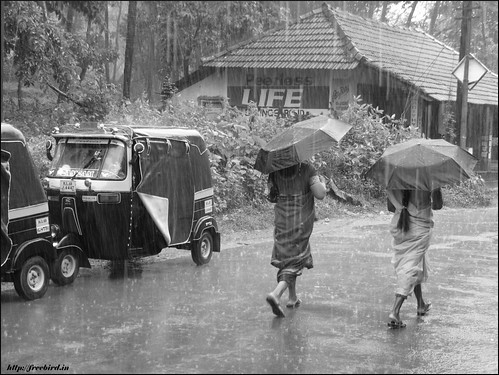
Flickr photo by freebird used under Creative Commons License
We were lucky enough to have a school within 5 minutes walking distance from home. But for many other children, some of whom had to walk upto 5 - 8 miles, it must have been the dreadful season balancing their books, lunch boxes and an umbrella, mostly through paddy fields with knee deep water. By the time they reached school, they would be wet to their skins and they had to spend the whole day with their wet clothes on. They had only an ottayadi patha or a narrow trail dividing two fields, made of mud to walk between the paddy fields. Many times if there was a breach in the mud trail and it was flooded with water, you just slipped and fell in it. Books got washed away, lunch boxes got washed away and still they would reach school with umbrellas in hand. It is quite a sight to behold little children leaving for school with their best dresses and umbrellas in hand. When we were children we had umbrellas made of palm leaves with a long bamboo handle which was known as olakuda or pattakuda. There were big ones and small ones and they were not foldable. This meant we needed lot of space to keep them when we reached school. Mothers wrote their childrens’ names inside the umbrellas so that they wouldn’t get mixed up. The olakuda had a large span and it fully protected us from the rains. The farm laborers used a modified version of this olakuda, which was much larger and conical in shape and had a cap like ring inside the umbrella which would sit on their head, thus holding the umbrella as they worked with both their hands.
After coming to Bangalore, we still had rains in the earlier years, but the charm was not there. You could not get wet in the Bangalore rains as the moment the rain falls it would become chill. We had rains throughout the year. Now Bangalore does not get much rains and I yearn for the Monsoon Magic of God’s own Kerala.
Sunday, June 29, 2008
Ayilyam and Moolam (redux)
There have been many desperate questions asked here regarding the ill effects of Moolam and Ayilyam. At the very outset, let me clarify that my inspriation for writing that blog post was only a phone call from a distressed father whose daughter’s birthstar was Moolam. It reminded me of the various sayings about various birth stars. They are all based on the customs being followed by the society at large. Other than that, I have not done any astrological or vedic research to find the truth behind these sayings.
As such, as I have written many people simply follow the custom, thinking that if so many people follow it, there must be something in it. At the same time, I have also heard from people who run to the astrologer for every small disturbance in their life that they don’t believe in the saying that girls born with Moolam and Ayilyam stars bring ill luck to the husband’s parents. I have also come across situations where the marriage of the boy has been delayed for long period because his birthstar is moolam or ayilyam, though the saying goes, “Aan moolam arasalum” (the man with bithstar moolam will rule the country).
All these beliefs came into existence when the marriages were fixed solely by the elders of the family and the groom and bride just tied the knots as per the elders’ wishes. They had no say whatsoever in the selection of their partners. The elders made sure that they selected the groom or bride as per their beliefs. There was no question of selecting a bride or groom if they thought the birthstars or horoscopes did not match. Many a time, the father or mother of the groom (when the other parent was not alive) came forward voluntarily to accept a girl with moolam or ayilyam, to the relief of the girl’s parents.
In today’s world, when most of the girls and boys select their partners, it is not possible to observe such customs. No girl or boy is going to find out about the other’s birth star when they start seeing each other. It would perhaps be prudent for the girls and boys to give enough importance to such matters, if they know about their parents’ views on these. It may save them from a lot of disappointment and distress, if they still want to get married with the blessings of their parents. Or else they should be brave enough to shoulder the responsibility of their decision. After all, as I have said, Moolam and Ayilyam are not considered to bring bad luck among many other communities in our society.
In the olden days, the horoscopes were matched by learned astrologers alone, whereas today we see that everyone has something to say about horoscope matching and hence so many right or wrong dos and donts. No one wants to ignore any astrological advice, whether coming from an astrologer or a common man. They are so confused and do not want to take any chances. I have even heard people saying that only 3 or 4 stars will match with some particular star and so on. All these things have made selection of a good alliance even more difficult.
As such, as I have written many people simply follow the custom, thinking that if so many people follow it, there must be something in it. At the same time, I have also heard from people who run to the astrologer for every small disturbance in their life that they don’t believe in the saying that girls born with Moolam and Ayilyam stars bring ill luck to the husband’s parents. I have also come across situations where the marriage of the boy has been delayed for long period because his birthstar is moolam or ayilyam, though the saying goes, “Aan moolam arasalum” (the man with bithstar moolam will rule the country).
All these beliefs came into existence when the marriages were fixed solely by the elders of the family and the groom and bride just tied the knots as per the elders’ wishes. They had no say whatsoever in the selection of their partners. The elders made sure that they selected the groom or bride as per their beliefs. There was no question of selecting a bride or groom if they thought the birthstars or horoscopes did not match. Many a time, the father or mother of the groom (when the other parent was not alive) came forward voluntarily to accept a girl with moolam or ayilyam, to the relief of the girl’s parents.
In today’s world, when most of the girls and boys select their partners, it is not possible to observe such customs. No girl or boy is going to find out about the other’s birth star when they start seeing each other. It would perhaps be prudent for the girls and boys to give enough importance to such matters, if they know about their parents’ views on these. It may save them from a lot of disappointment and distress, if they still want to get married with the blessings of their parents. Or else they should be brave enough to shoulder the responsibility of their decision. After all, as I have said, Moolam and Ayilyam are not considered to bring bad luck among many other communities in our society.
In the olden days, the horoscopes were matched by learned astrologers alone, whereas today we see that everyone has something to say about horoscope matching and hence so many right or wrong dos and donts. No one wants to ignore any astrological advice, whether coming from an astrologer or a common man. They are so confused and do not want to take any chances. I have even heard people saying that only 3 or 4 stars will match with some particular star and so on. All these things have made selection of a good alliance even more difficult.
Saturday, June 21, 2008
Elsewhere In The Empire
The Blandings Media Empire never sleeps. While I'm taking a break from blogging here, I've put up a new post on my stories blog. The story of two cats and a monkey and sharing everything alike is up on Kathai Kathaiyam Karanamam. Meanwhile, my handsome and charming son continues to chronicle his discoveries in India: Interesting advertisements on TV, the new Bangalore airport (messes and all), and much much more. He seems to be much more prolific than I.
Friday, June 06, 2008
Recipe: Aavakkaya

Aavakkaya is the pickle synonymous with Andhra Pradesh. The utterance of the word “Aavakkai” tickles the taste buds. And when you make it, you cannot but help your mouth watering. The aroma of the newly made pickle is so intoxicating. Aavakkaya literally means pickled with mustard powder (aavalu in Telugu means mustard) and rightly so, mustard powder is the main preservative here along with gingelly oil.
When one of my son’s assistants brought home a basket full of mangoes, I was at a loss not knowing what to do with so many raw mangoes. I asked him why he brought so many mangoes when I would have been happy with 2 or 3. “Pickle them, Mummyji,” he said. That’s when I thought of making Aavakkaya. As I had not made this pickle in recent times, I called my friend Sujatha, to ask for the method. She promptly said, “I will come tomorrow and help you. Keep chilli powder, salt, mustard powder and oil and other things ready.” I was only too happy to get the things ready, as I did not have to worry about the final product. I have been getting to taste Sujatha’s mother’s Aavakkaya every year. And they are superb.
She specifically told me not to buy the mustard powder, but to buy mustard, sun dry and grind them fresh. "Or else," she said, "the pickle will taste bitter." So I went and bought all the ingredients and sun dried them . I also washed all the mangoes thoroughly and dried them in shade, by spreading them in a clean towel, to remove all moisture.
Sujatha came promptly at 11 am next morning and we started the preparation.We cut the mangoes into large pieces and measured them. Accordingly we measured the other ingredients. Here is the ratio:
Ingredients:
Raw mango pieces: 5 measures ( approximately 3.5 Kg)
Red chilli powder : 1measure (I used 300gms. One may add upto 500gms., depending on individual preference)
Freshly ground mustard powder: 1 measure ( here again those who like the taste of mustard oil can use upto 500 gms )
Salt: 1 ¼ measure(8oogms)
Whole fenugreek seeds: 50 gms
Turmeric powder: 2 tbsp.
Good quality gingelly oil: 1 ltr
Method:
The mangoes should have firm stone inside.(the stone should be attached to the flesh of the mango and when cut through, the stone should still be attached to the mango pieces.) Wash and dry the mangoes in a clean towel in shade. Cut them into large pieces.Discard the soft seed portion .
Keep the other ingredients ready(in the proportion given above).

Keep a large glass jar or earthenware jar washed and sun-dried, ready. (As I was in Hyderabad, where I function with minimum kitchen gadgets, I did not have a glass jar or earthenware jar. Hence I used a large pet jar).
Now comes the most difficult part. Mixing the ingredients. Sujatha insisted on mixing them with hands. I would have preferred mixing them with a large spatula, as my skin is very sensitive to chilli powder.

Mix all the dry ingredients(chilli powder, mustard powder, salt,turmeric powder and fenugreek seeds) thoroughly. Take another large shallow pan for the final mixing. Into this pan, transfer a portion of the cut mango pieces. Add a portion of the pickle masala to the mangoes. Pour 1 or 2 spoonfuls of gingelly oil and mix the contents thoroughly with hand or a spatula. Transfer them to the jar. Repeat this process, until all the mango pieces and pickle masala are used up. Top the jar with the remaining oil and pickle masala, if any. Keep the jar in a cool dry place. Within an hour, you can see the gravy oozing out of the mango pieces and within 2 to 3 hours, there would be a 1”top layer of oil and gravy above the mango pieces(called “Oota” in telugu). This is the sign of right quantity of ingredients, said, Sujatha’s mother, when I called her to report the event. Stir it thoroughly with a dry spoon every day for 5 days, she said. I followed her instructions and the results were just superb.

Thursday, May 08, 2008
Recipe: Ambode

Immediately after the obattu post, I was ready with this post for Ambode, another Ugadi speciality. What with the burning hot summer and a tooth problem that required a root canal treatment, I just got too busy. The truth is I try to keep myself busy to the brim always. Be it summer, winter or rains. It’s good, say my friends. It’s bad, feel I. Anyway, the fact is I am busy.
How does one keep oneself busy during summer? I for one, start making all sorts of sun-dried wafers (vadams, karuvadams and vattals) to keep for the whole year. And then comes pickling. Summer is the season we get plenty of mangoes and is the right season for mango pickles. This year I made “Aavakkai” after a long interval. The aavakkai that I made this year is so special because, I made them with Andhra mangoes and under the guidance of a true Andhra friend and it turned out just yummy and truly fiery. More about vadams and aavakkai later (immediately, I promise), we will go on with Ambode.
Ambode (Kannada) or Aamavadai (Tamil)or Parippuvada (Malayalam) are all very close siblings, with as much difference as one can notice among siblings. Ambode takes the prize, I should say. I have learnt the secret of crispy, mouth watering ambode from Mrs.Shakunthala, whose ambodes are a treat any day. She is the official ambode maker, whenever our “Soundrya Lahiri” teacher arranges a Pooja and each time the ambodes turn out just as yummy. Let us get on with the recipe, without much ado.

Ingredients:
Chana dal: 2cups.
Green chillies: 3or 4 according to taste
Dry red chillies: 1 or 2
Pepper corns: 1 tsp.
Jeera: 1tsp
Hing: 2 tsp or size of a pea
Curry leaves: few
Coriander leaves: 2 tbsp.
Grated fresh coconut: 2 tbsp.
Cinnamon: 1/2 “ piece
Cloves: 4 nos.
Ginger: 2” piece
Salt to taste
Ghee: 1 tbsp.
Raw rice flour: 1 tbsp.
Oil for frying
Optional
Finely cut onions: 2 tbsp
Crushed garlic: 1 tsp
(When making ambode for offering as Neyvedyam, I usually do not add onions and garlic, however they definitely add to the taste, no doubt)
Method:
Wash and soak the chanadal with hing, peppercorns, jeera, green chilies and red chilies for 1 hr. Crush the cinnamon and cloves separately (this will not get crushed with the other ingredients, if ground together in the mixer). Drain the soaked chanadal with other ingredients to remove all water and grind coarsely with curry leaves ,giner,crushed cinnamon and cloves and salt. Transfer to a bowl and mix the grated coconut, rice flour, finely cut coriander leaves and ghee. If using onion and garlic, add the finely cut onions and crushed garlic also. Mix well.
Make small balls of the ground mixture. Heat oil in a pan. When the oil is hot, reduce the heat, but retain the temperature of the oil. Take the prepared balls in your palm and pat lightly with the fingers and slide into the hot oil, one by one. Turn the ambodes once inside the oil, so that both sides get cooked evenly. Remove from oil, when both sides are cooked, drain and serve the crispy ambodes with pudina chutney or tomato sauce.
The less experienced can pat the ambodes on a plastic sheet and gently slide them into oils, taking care not to splash the oil.
NJOY!
Saturday, April 12, 2008
Recipe: Obattu

Happy Ugadi to all. It is new year’s day for many people on Ugadi or Yugadi. The new year that has dawned is known as Sarvadhari . The Sarvadhari varsha for people in Tamil Nadu and Kerala who observe Suryamana Ugadi starts on the 14th April.
As always festivals mean good food and also food made of seasonal fruits and vegetables. The season is also the start of spring or Vasantha rithu in India and trees and plants are blooming after the gloomy winter months. The neem trees are full of fragrant blooms. Hence the use of neem flowers in cooking on this new years day. Neem flowers have anti fungal, antibacterial and anti diabetic properties. In Karnataka, the ritual is called eating bevu bella or neem and jaggery, bitter and sweet to symbolize that life is full of sweet and bitter turns.
In Andhra, the ritual is to make a chutney known as Ugadi pachadi using neem flowers, mango, jaggery, chili powder and salt. These raw ingredients are mixed and served as pachadi. This is supposed to cleanse the system.
Besides Ugadi Pachadi the special dishes prepared for Ugadi are Obattu and Ambode in Karnataka. I understand Andhra people also make obattu(known as bobbatlu in telugu) and Pulihore and payasam and vadas.
It is my long-standing promise to post the recipe for Obattu and Ambode. The time has at last arrived, with my making obattu and photographing them.
Obattu or Holige(Kannada), Poli(Tamil), Upputu(Kerala iyer), Bobbatlu(telugu), Puran Poli(Marathi) all refers to stuffed sweet parathas made of Maida. The sweet stuffing can be made from a variety of ingredients, most popularly using chana dal, jaggery and coconut. Kannadigas use equal quantity of chana dal and toor dal and coconut. This filling can be prepared using only coconut and jaggery or green gram dal and coconut and jaggery (Kerala Iyers make uppitu with this stuffing) and in the new age, the sweet stuffing can be made with carrot, coconut and jaggery to give a vegetable touch to it (healthy and nutritious as the presenters of tv cookery shows like to say). And again the rolling is done like parathas or on banana leaves.
Given below is the recipe for Karnataka obattu, as prepared by my authentic Kannadiga friend, Veena.
Ingredients:
Filling:
Chana dal: 250 gms.
Fresh grated coconut: 1½ cups
Grated jaggery: 2½ cups
Dry ginger power: 2 tsps.
Cardamom powder: 2 tsps.
For the outer covering:
Maida: 250 gms
Salt : a pinch
Turmeric powder: 1 tsp.
Gingelly oil: ¼ cup
Water to knead the dough
Ghee for brushing on the obattu
Preparation:
First make the dough by kneading the maida with salt and turmeric powder and water to a soft and elastic consistency in a large bowl or plate. Add 2 tbsps.of gingelly oil and knead again. Make a well in the centre of the dough and add the remaining oil and keep it aside for 10 minutes. Knead again incorporating the oil well into the dough to make the dough more elastic and pliable. Keep the dough covered with a moist cloth. The quantity of oil could be increased to get more pliable dough or if you are calorie conscious, decrease the quantity of the oil (honestly speaking let go when making obattus, if the quantity of oil is decreased the obattu do not come out as flaky and tasty).
To prepare the filling, cook the chana dal with just enough water to cover the dal in a pressure cooker until just done (Do not over cook). Strain to remove the water. (Kannadigas use this water to make a special rasam ). At this stage I deviate a little from Veena’s method.
Veena continues thus: She heats the strained dal, coconut and jaggery in a kadhai until all the moisture evaporates then cools and grinds the mixture and adds cardamom powder and dry ginger powder to get the stuffing.
As I have always said, I like to strain the jaggery to remove the dirt and sand, hence the following method. Grind the strained dal and grated coconut .Boil the jaggery in ½ cup of water until the jaggery dissolves. Strain to remove the sand and other dirt particles. Pour into a heavy bottomed kadhai and boil until the syrup starts thickening. Add the ground dal and coconut mixture and continue stirring until the mixture starts leaving the sides of the pan. Remove from the stove, add cardamom and dry ginger powders. Mix well and cool. Make lemon sized balls of this mixture and keep aside.
Knead the dough once again. (People with weak shoulders like me may use a electric kneader for this to get excellent result or else seek the help of your better half like I do). Take small quantity of the dough and pat into a small circle with the palm of your hand on a banana leaf or plastic sheet. Place one ball of the filling in the centre and close from all sides. Pat the ball into a thin paratha with the palm of your hand. Heat a tava. Gently remove the obattu from the plastic sheet and roast on the heated tava on both sides until brown spots appear. Remove from the tava and drizzle ghee on it. Repeat with the remaining dough and filling. Serve the “Melt in the mouth hot obattu“ drizzled with ghee and enjoy your holiday with your family.
To add to the sweet taste,Kannadigas serve this obattu with a payasam made of khuskhus, coconut milk and jaggery . We love it with ghee.
ENJOY!
Sunday, March 16, 2008
Karadayan Nonbu 2008

I am sure all of you would have celebrated Karadayan nonbu in the traditional manner. I celebrated it as usual with sweet and salty adais. As the time for the nonbu this year was a convenient breakfast time there was no hassle of preparing a separate breakfast. That helped a lot in getting ready for the Puja. This time round, I am in Hyderabad and we have an Arali tree right in the front yard. So Arali flowers were no problem. The adais came out perfect also. On the whole, a very satisfying nonbu.
It gives me great joy to see that a great many people have visited my blog on the eve of Karadayan nonbu. This invariably means that even in the midst of a very busy life, people want to keep up with our traditions and observe the important rituals for the well being of one and all. Festivals like these inculcate our rich culture in the growing children of today, especially since most people live far away from their native places and people have to be extra vigilant to remember these festivals that are popular only among a select set.
As always, on such festival days, I go back down the memory lane and try to remember how I celebrated nonbu in the previous years. In my Puthucode days, the nonbu was a big festival as everyone around was celebrating it. The whole village was filled with fragrance of roasted rice flour and Arali flowers. In Bangalore some years later, we were the only people celebrating in the whole street. Of course my sister-in-law would come visiting bringing her adais. This time around perhaps I am the only one celebrating the festival in the whole colony. Each nonbu has been different from the other, in one way or the other.
All said and done, my Puthucode nonbu always tops my sweet memories. It was totally relaxed for everyone. There was no last minute shopping to do and most importantly the whole run-up to the nonbu was delegated efficiently and each person got a job that she was capable of; a little girl of 5 would be asked to keep the flowers in the neyvedyam leaves and an older girl would have to get the flowers from the garden and string them. The preparations started well in advance with the maid pounding the rice. She knew exactly how much rice was to be pounded, though she would ask my echiyamma, “Shall I bring 1 kg of rice from the pathayam (a wooden box in which rice was stored).” My echiyamma would say, “I think it should be sufficient, or else take 1-1/2 kg”. Having got the rice pounded well in advance, there was enough time to roast the flour. Even if by chance my mother didn’t get the time to do it immediately, there would always be some neighbours dropping by just to say hi to my Echiyamma. During the conversation, either they would ask or my echiyamma would enquire of them “Singari (or Lakshmi or Ammu or Chellam as the case may be) have you roasted the rice flour for nonbu?” to which she would reply, “Yes echiyamma, I had some free time last evening”. Then my echiyamma would say, “Sita has not found time to roast the flour”. Dear Singari mami would immediately come to the kitchen and tell my mother, “Sita, where is the rice flour? While I am here, I might as well roast it for you”. In 5 minutes the rice flour was roasted, in between exchanging some juicy gossip from the village. Nobody considered it a burden to lend a helping hand to anyone, even if they had spent the whole day working in their own kitchen. Singari mami would be properly rewarded when the next lot of mangoes or jackfruits or other such things came from our farmhouse. And we all thought we were one family. There was never a feeling of haves and have nots among the whole village. My mother would think nothing of leaving a crying baby with Singari mami to be taken care of while she was very busy. Singari mami was only too happy to take care of a wailing baby, though she had her own house filled with growing grandchildren. I can just indulge in this reminiscing game forever and forget all about my surroundings. So sweet were those days and the nonbu adais!
Wednesday, February 27, 2008
Recipe: Maasi Pournami Payasam

The payasam made on Maasi Pournami day invariably was made with milk, jaggery and rice. It had a special taste, as it was made with milk from the home reared cow which grazed on natural organic grass. The method is very simple and it tasted delicious.
Ingredients:
Rice: 4 tbsp.
Full cream milk: ½ litre
Powdered jaggery: 1 cup
Boil the powdered jaggery with 1 cup of water. When the jaggery dissolves, strain to remove the impurities and sand particles. Keep aside.
Wash and drain the rice. In a pressure cooker add the milk and 2 cups of water and bring to boil. Add the rice and lower the heat. Place the weight on the weight valve, when there is a steady steam coming out. Cook for 20 minutes and switch off the stove. When the pressure cooker cools down, open the lid and add the strained jaggery mixture and boil until the payasam thickens.
Offer to the Gods and enjoy with your family and kids from the neighbourhood.
May your kids have a long and healthy life!
Maasi Pournami
Sometime back I had promised to write about maasi pournami. Pournami is the full moon day and Maasi Pournami is the full moon day in the tamil month of Maasi(February-March). Almost all full moondays are celebrated in a special manner with some festival attached to the day. These full moondays are also known by the star with which the Pournami concides. Like in the month of Maasi the Pournami falls on the star Makam and hence is also known as Maasi Makam. In the following month , Pankuni(March-April) it falls on the star Uthiram and hence the day is celebrated as Pankuni Uthiram and so on.
The Maasi makam festival is celebrated in many Devi temples and Siva temples in Kerala and Tamilnadu.
Maasi Pournami for us during our childhood was a day of literally getting drunk with payasam. On this day, all the households made payasam in the evening and offered it to the Moon God, praying for the long life and good health of the children. The payasam was then distributed to all the children in the neighbourhood. When the children are happy they in turn wish the family and making children happy meant making the Gods happy. We children invited all the other children in the neighbourhood to have payasam at our home and in turn got invited to all the other houses.
Children were made to sit in the open in the backyard,(which in most of the houses was paved) and payasam was served in banana leaves with a piece of coconut and jaggery and a plantain.. We were also given 5 paise or 10 paise coins at the end of the feast. 5 paise or 10 paise meant a lot those days. We could, for example, buy an ice stick (just frozen sweetened water, which we thought was the ultimate goody) or a toffee or take a raffle from the neighbourhood shop, which promised things like sunglasses and cameras and all of us ultimately got a comb or a whistle or just a toffee.
We had to go to all the houses for tasting the payasam and by the time the evening closed, we all would be so full that we just could not think of food for many more days to come. And so we thought, and we would slowly amble towards our houses and whom should we meet on our way. The lady of the house which we had missed tasting the payasam and she would not let us go without having her payasam. We all would then share the story of Lord Ganesha who was mocked by the Moon God, and was in turn cursed by the Lord. By the end of the evening when we reached home, we did not have strength even to stand. Those were fabulous times.
There was another ritual also on Maasi Pournami day, which was known as “Aimparai”. A necklace was made by threading 5 coins made of copper, iron, silver, brass and an alloy of iron, silver and copper which was then given to of children below the age of 5 years. This was supposed to protect them from evil eyes and all childhood related health problems.
Even today, I celebrate Maasi Pournami by offering Payasam to the Moon God. Until a few years ago, when my brothers and families lived only 2 kms away, they came around to have payasam in our house. Now that they have moved a little farther away and the children have grown up, I don’t have any little kids to offer the payasam, unless some family visited us with their kids per chance. I continue to make payasam.
The Maasi makam festival is celebrated in many Devi temples and Siva temples in Kerala and Tamilnadu.
Maasi Pournami for us during our childhood was a day of literally getting drunk with payasam. On this day, all the households made payasam in the evening and offered it to the Moon God, praying for the long life and good health of the children. The payasam was then distributed to all the children in the neighbourhood. When the children are happy they in turn wish the family and making children happy meant making the Gods happy. We children invited all the other children in the neighbourhood to have payasam at our home and in turn got invited to all the other houses.
Children were made to sit in the open in the backyard,(which in most of the houses was paved) and payasam was served in banana leaves with a piece of coconut and jaggery and a plantain.. We were also given 5 paise or 10 paise coins at the end of the feast. 5 paise or 10 paise meant a lot those days. We could, for example, buy an ice stick (just frozen sweetened water, which we thought was the ultimate goody) or a toffee or take a raffle from the neighbourhood shop, which promised things like sunglasses and cameras and all of us ultimately got a comb or a whistle or just a toffee.
We had to go to all the houses for tasting the payasam and by the time the evening closed, we all would be so full that we just could not think of food for many more days to come. And so we thought, and we would slowly amble towards our houses and whom should we meet on our way. The lady of the house which we had missed tasting the payasam and she would not let us go without having her payasam. We all would then share the story of Lord Ganesha who was mocked by the Moon God, and was in turn cursed by the Lord. By the end of the evening when we reached home, we did not have strength even to stand. Those were fabulous times.
There was another ritual also on Maasi Pournami day, which was known as “Aimparai”. A necklace was made by threading 5 coins made of copper, iron, silver, brass and an alloy of iron, silver and copper which was then given to of children below the age of 5 years. This was supposed to protect them from evil eyes and all childhood related health problems.
Even today, I celebrate Maasi Pournami by offering Payasam to the Moon God. Until a few years ago, when my brothers and families lived only 2 kms away, they came around to have payasam in our house. Now that they have moved a little farther away and the children have grown up, I don’t have any little kids to offer the payasam, unless some family visited us with their kids per chance. I continue to make payasam.
Wednesday, February 20, 2008
Recipe: Semiya Payasam

We will start with a delicious sweet once again. Though most of us are familiar with semiya payasam, I have found that the payasam just doesn’t taste as good. My beautiful and talented niece says, “Athai’s payasam tastes just like ice cream.” Our sons say, “ammas special payasam, nobody else makes it as delicious and lip smacking.” Enough about self glorification. Let’s go straight to the recipe.
Ingredients:
Semiya (Vermicelli) : ¾ cup
Full cream Milk: 1 litre
Sugar: ¾ cup
Ghee: 2 tbsp.
Cashew nuts: 8 nos.
Raisins: 1 tbsp.
Cardamom powder: 1 tsp.
Method:
Heat 1 tbsp. of gheee in a wide mouthed, thick bottomed pan. Break the cashew nuts into small pieces and fry them in the ghee to a golden color, remove. Add the raisins fry them until they are fluffy, remove. Add the remaining ghee and fry the vermicelli to a golden brown. Add ½ litre of milk and boil, stir occasionally so that the milk doesn’t get burnt nor boil over. When the vermicelli has absorbed all the milk, add some more milk and allow the vermicelli to cook well. It will take approximately 20 minutes. When the vermicelli is cooked (it should be mushy in consistency), add the sugar and remaining milk. Boil for some more time until the payasam is thickened. Remove from the stove and add the cardamom powder. Garnish with fried cashew nuts and raisins.Yummy and delicious semiya payasam is ready. The whole process of preparing takes about 30 minutes. When you have unexpected guests and you want to serve them a delicacy, this IS THE DISH.
ENJOY!
Tuesday, February 19, 2008
Welcome to The Empire
Once again a long period of inactivity (only in blogging). I was fully occupied otherwise, which was the cause of my not spending enough time on this blog. Among the very important assignments, one of which was searching for a perfect match for my younger son of course, we were also busy with creating 2 other blogs.
Kathai Kathayam Karanamam is a blog that has been in gestation for a very long time. This is an attempt to share the stories we had heard as children and also what I had read to my children when they were little. The first story is already up, Matha Pitha Guru Deivam. We will be adding many more, please visit often and give me suggestions as always.
Our younger son who returned to India after spending more than a decade in the US has started blogging his experiences in India of today, from an outsider’s point of view. He is writing Just Landed.
Now that we have 3 blogs going, we are now officially a media empire. We are all part of the ever-expanding Blandings Media Empire.
Hope you enjoy reading both the blogs.
Happy Reading.
Kathai Kathayam Karanamam is a blog that has been in gestation for a very long time. This is an attempt to share the stories we had heard as children and also what I had read to my children when they were little. The first story is already up, Matha Pitha Guru Deivam. We will be adding many more, please visit often and give me suggestions as always.
Our younger son who returned to India after spending more than a decade in the US has started blogging his experiences in India of today, from an outsider’s point of view. He is writing Just Landed.
Now that we have 3 blogs going, we are now officially a media empire. We are all part of the ever-expanding Blandings Media Empire.
Hope you enjoy reading both the blogs.
Happy Reading.
Monday, January 28, 2008
Thai Pirandal
Thai Pirandal Vazhi Pirakkum is an adage in Tamil, which translates into “when the month of Thai (Jan 14th) starts, all roads open up”. This is especially said in connection with marriages. Marriage season starts with Thai in the south because Uttarayanam is considered to be the best season for conducting functions like marriage, upanayanam etc. Moreover, in the olden days, by the time of Thai people were a little free after the harvesting and had time to attend to the time consuming job of searching for and conducting the marriages of their children.
I am continuing this blog post at this blog
I am continuing this blog post at this blog
Sankranthi 2008

Sankranthi is over and the sun has started its journey towards the northern hemisphere (uttarayanam). The days have started becoming a little longer and warmer and the birds are back chirping.
This time around I was in Hyderabad during Sankranthi. Though I did not get to see much of the Sankranthi celebrations of the people of Andhra Pradesh, I was invited to an interesting ritual and since it involved little children, I enjoyed it all the more.
We were invited for an Annaprasanam ceremony of our son’s friend’s baby on the 14th morning. Since we could not make it to the morning function, we visited them in the evening. “We have a function in the evening also,” they said. I thought there would be a function in connection with the annaprasanam of the little one.
This ritual is called Bhogi Pandulu. A mixture of regi pandulu (a type of berry that flooded the markets the previous day and I was wondering what these would be used for), flower petals, colored rice (Akshatha), coins, and sugar cane pieces were kept ready on a decorated stool. There was another decorated seat to seat little children below the age of 5. The house we visited had a 6 month old baby and another little girl, both dressed in their best and looking stunningly beautiful. All the ladies from the neighbourhood and older relatives of the family were assembled.
Around 5 pm, all the members present showered the mixture of flowers and colored rice (they said they did not include sugar cane pieces and coins as it might hurt the little baby) on the children, one by one. Even the male members of the family showered the petals. After this, Arathi was done to the children. The invitees were given thamboola with fruits, betel leaves, kumkum and soaked chickpeas.
This function symbolizes the seeking of blessings from the elders for a healthy and long life for the little ones and also to ward off all evil. I was reminded of a similar ritual called Aimpara, conducted in our tradition during the full moon day of the tamil month of Masi (between Feb 14th –March 14th). More about that later.
Monday, January 14, 2008
Recipe: Bisi Bele Bhath

I have spent more time now in Karnataka than in my native Kerala that it would be unpardonable not to write about authentic Karanataka cuisine. What other recipe can be more authentic and originally Karnataka than the now world famous Bisi Bele Bhath? Bisi Bele Bhath in Kannada means hot dal and rice. It is simply that. Perhaps originally it was only hot rice and dal. Now it has progressed to a complete filling meal with dal, rice and all sorts of vegetables.
In our earlier years in Bangalore, we lived in a largely tambram area and hence did not have much contact with the native Kannadigas. The only bisi bele bhath we tasted were at the wedding receptions, which on those days were mostly conducted in dim choultries and food served on greasy plates. The bisi bele bhath served was too spicy for us and hence I never attempted to learn the recipe. Moreover our handsome and charming younger son never liked the food served on such occasions, so much so, even before we set out, he would ask us, “are they serving food in banana leaf or kozhakozha plate(greasy plate)”. So most of the time if it were kozhakozha plate, we just came away for our curds rice at home. It was only after I knew my best friend Veena, who is an authentic Kannadiga to the core, that I got to taste the delicious homemade bisi bele bhath and ever since it has become a favorite of not only of all at home but of all our guests also. They often say,”The bisi bele bhath served at the hotels is so spicy, your bisi bele bhath is very tasty”.
Here then is the recipe for the bisi bele bhath masala powder. It may be made in advance and kept in air tight jars so that bisi bele bhath can be prepared in a jiffy any time.
Ingredients for the masala:
Dhania: 100gms
Red chillies : 100gms
Chana dal(Bengal gram dhal): 100gms
Urad dhal: 100gms
Dry copra: 100gms
Cinnamon : 10 gms
Marathi moggu: 5 pieces
Cloves: 1 tsp.
Method:
Dry roast all the ingredients except copra separately (as each one will turn pinkish at different temperatures) to a pink color or until a nice aroma emanates from them. Grate the copra and add to the fried ingredients. Grind to a fine powder and store in air-tight jars.
The quantity of red chillies may be increased or decreased according to personal taste.
Making of Bisi Bele Bhath
Bisi Bele Bhath is a very versatile dish and any vegetable can go into it. Though many people don’t use ladies fingers and brinjals (which would turn mushy when cooked) I would say any vegetable would add that extra taste to it. So use any vegetable you like.

The following quantity will suffice for 6 servings.
Ingredients:
Carrot: 50 gms
French beans: 50 gms
Green peas: 50gms
Knol khol: 1 small
Cauliflower: few florets
Potato: 1 medium
Double beans: 50gms
Cabbage: 50 gms
Chayote : 50gms
Tomato: 150 gms
Curry leaves : few sprig
Coriander leaves: few
Fresh coconut: 2 tbsp.
Tamarind : marble size or
Tamarind paste: 1 tsp.
Fresh ground nuts: 2 tbsp.
Rice : 1cup
Toor dal: 1 cup
Bisis bele bath powder: 2 tbsp.
Turmeric powd: 1 tsp.
Jaggery : 20gms.
Salt to taste
For garnish
Ghee: 1 tbsp.
Mustard seeds: 2 tsp.
Red chillies: 2 nos.
Cashew nuts (optional) : few
Hing : 1 tsp.
Method:
The whole meal can be prepared in a pressure cooker in one go. That’s how I do it.
Soak the ground nuts in water for 2 – 3 hours. Wash and Chop all vegetables to 1” squares. Shell peas and double beans. Wash and drain the rice and dal.
Soak the tamarind in ½ cup of warm water.
Unlike the other “mixed rice preparations” the bisi bele bath should be well cooked and should be in a semi solid consistency.(kozhayae in tamil).Accordingly add 3 cups of water for each cup of rice, 2 cups of water for each cup of dal and one cup of water for each cup of vegetables.
Boil water according to the above proportion in a pressure cooker and add all the vegetables, soaked ground nuts, rice, dal and turmeric powder and close the pressure cooker. Put the weight on when steady steam comes out of the weight valve and cook for 3 whistles. (I usually reduce the heat at the first whistle and allow another whistle in reduced heat and switch off the stove).
Allow the pressure cooker to cool. Open the lid and check if the rice is cooked well and there is enough water content. If not add one more cup of water and boil, adding the jaggery, bisibele bath powder and salt. Extract the juice out of soaked tamarind and add to the boiling rice. Add half the ghee also to the mixture. Boil for 5- 10 mnts stirring well taking care not to burn the contents (this happens because the contents are very sticky). Add the fresh coconut gratings. Switch off the stove and add a few springs of curry leaves.
For garnishing:
Heat the remaining ghee in a pan. When the ghee is hot, add the hing powder, mustard, cashew nuts, broken red chillies and few curry leaves. When the mustard stops spluttering and the cashew nuts turn to a pink color, add the contents to the prepared rice. Garnish with finely cut coriander leaves .
Serve with chips, papad or vadam
Enjoy Pongal with Bisi Bele bhath.
HAPPY PONGAL!
Monday, December 31, 2007
Happy New Year

Wishing everyone a very happy and prosperous new year.
May the year ahead tickle your tastebuds.
Saturday, December 29, 2007
Recipe: Carrot halwa

It has been our practice for long to prepare carrot halwa, especially during the winter as we get the red variety of carrot (which is known as delhi carrot in Bangalore) then. Otherwise, what we get is the orange variety. So during my Bangalore visit, we bought the red carrot and prepared the halwa. The most difficult part of carrot halwa is grating the carrot, which our handsome and charming younger son happily did. I started part of the preparation immediately (read at 10 pm) and completed the process early next morning, so that when my good friend Veena came to say “hello” to me at 7 am the carrot halwa was ready and she was surprised that I had finished the preparation so early in the morning, whereas she had just woken up and come to wish me.
I used full cream milk and the halwa turned out creamy and rich and of course, yummy. Here is the recipe then.
Ingredients:
Grated carrot: 4 cups
Full cream milk: 3 cup
Sugar: 2 cups
Ghee 4 tbsp.
Cashew nuts: 1 tbsp.
Kismiss(raisins): 1 tbsp.
Slivered almonds : 1 tbsp.
Cardamom powder: 1 tsp.
Saffron : few strands
Method:
Boil the milk in the pressure cooker and add the grated carrots. Close the pressure cooker and reduce the heat to the minimum . When there is a steady stream of steam through the weight valve, place the weight and cook for one whistle or 15 mnts in reduced heat. Turn off the heat. (This is the first stage of preparation ). Open the cooker after ½ hour. Meanwhile, soak the saffron strands in 2 tbsp. of milk. Add the saffron to the cooked carrot. Boil the carrot once again on full heat. Add the sugar and stir constantly until all the milk evaporates. Add spoonsful of ghee in between whenever the halwa starts sticking to the vessel. When all the ghee (Reserve 1 tbsp of ghee for frying the dry fruits) has been added and all the moisture evaporated, the halwa should leave the sides of the vessel. Turn off heat. Add cardamom powder. Heat the reserved ghee in a small kadai, add the cashew nuts and kismiss. When the cashew nuts turn pink in color and kismiss swells add to the halwa as garnish. Decorate with slivered almonds.
The full cream milk gives that extra richness and taste to the halwa (you get the twin taste of halwa and thirattupal).
NJOY!

Merry Christmas
During the Christmas weekend I paid a flying visit to Bangalore and back which was eventful and hectic to say the least. Well, we had Thiruvathira, Christmas, visitors for lunch and brunch, personal work to attend to and generally oiling up for the smooth functioning when I am away. Before I left I made sure that our elder son would not have any difficulty during my absence by cooking and freezing a few things and before I left Bangalore I had to once again see that my husband and our younger son would have a few things for their immediate use after I left.
For Thiruvathira I made Kali and kari the usual thiruvathira goodies, exactly the same way as I had explained earlier and it turned out just right. This time, we used, Kavathu, red pumpkin, avaraikkai, sweet potatoes and fresh thuvar peas.Our younger son, who is back home for Thiruvathira after a long time, enjoyed the kali and kari.
Immediately after reaching Bangalore, the first thing we (my husband and I) did was to chop and soak the dry fruits for the Christmas cake. This time, we used, almonds, walnuts, pecans, cherries, dates, cashew nuts, raisins, pineapple, figs, prunes and ginger. We baked a cake with 1 kg of dry fruits, 6 eggs, 225gms each of flour and butter and sugar. Our younger son who is always ready to do the beating and mixing of the cake took over the responsibilities and I just had to oversee the process and the actual baking. The cake was fluffy and spongy and melted in our mouths.
During my visit, we also entertained my son’s friends. For one couple we prepared vangi bath, puttu and kadala kari, masala dosa and rava kesari. For another friend’s visit, we prepared, bisibele bath, curds rice and neypayasam.
In between we also prepared carrot halwa, porivilangai and pori undais, peas pulao, Aloo ki tehni and Rice ada.
I shall soon start posting the recipes of all the goodies for which recipes have not been posted.
For Thiruvathira I made Kali and kari the usual thiruvathira goodies, exactly the same way as I had explained earlier and it turned out just right. This time, we used, Kavathu, red pumpkin, avaraikkai, sweet potatoes and fresh thuvar peas.Our younger son, who is back home for Thiruvathira after a long time, enjoyed the kali and kari.
Immediately after reaching Bangalore, the first thing we (my husband and I) did was to chop and soak the dry fruits for the Christmas cake. This time, we used, almonds, walnuts, pecans, cherries, dates, cashew nuts, raisins, pineapple, figs, prunes and ginger. We baked a cake with 1 kg of dry fruits, 6 eggs, 225gms each of flour and butter and sugar. Our younger son who is always ready to do the beating and mixing of the cake took over the responsibilities and I just had to oversee the process and the actual baking. The cake was fluffy and spongy and melted in our mouths.
During my visit, we also entertained my son’s friends. For one couple we prepared vangi bath, puttu and kadala kari, masala dosa and rava kesari. For another friend’s visit, we prepared, bisibele bath, curds rice and neypayasam.
In between we also prepared carrot halwa, porivilangai and pori undais, peas pulao, Aloo ki tehni and Rice ada.
I shall soon start posting the recipes of all the goodies for which recipes have not been posted.
Sunday, December 23, 2007
Recipe: Muthucharam

Isn’t it a beautiful word? Muthucharam in tamil means string of pearls. Why this name was given to this crispy savory I cannot understand, as it definitely doesn’t resemble a string of pearls. Actually it is not called Muthucharam but called Muthuswaram which again doesn’t make any sense, so I thought Muthucharam atleast makes sense. Its common name, Mullumurukku is the apt word to describe this crispy as it has an exterior resembling thorns(Mullu). As I always say, a rose by any other name ……. And yet when we start analyzing the meaning of some of the words in common use, we start doing research.
The recipe here is very simple.
Ingredients:
Raw rice: 3 cups
Chana dal: 2/3 cup
Whole moong : 1/3 cup
Urad dal: 1 tbsp.
Gingelly seeds: 1 tsp.
Butter: 50 gms.
Hing: slightly larger than a pea
Salt to taste
Oil to fry
Method:
Wash and dry the rice. Dry roast the chana, moong and urad dal until nice fragrance emanates (the dals turn a light pink in color). Grind them all together to a fine powder. Grind the rice also to a very fine powder. I still have the privilege of getting it powdered in a flour mill. In many places I am told that flour mills have become a thing of past. Sieve the powders with a fine mesh to remove any coarse particles. Mix both powders thoroughly.
Soak the hing in little warm water atleast 1 hr before the actual preparation. Beat the butter and salt vigorously in a large kadai or thali. Dissolve the hing thoroughly in water. Add the prepared powder to the butter mixture and add the hing solution and make a soft and smooth dough by adding more water if necessary. This takes some effort. Usually I get it done by hubby dear who is only too willing to oblige. He likes to be part of everything that happens at home. If I make murukkus, he will knead the dough for me. If I make halwa he will stir the mixture for me. Anyway, today I am in Hyderabad and he is in Bangalore and my shoulder muscles get sore if I put a little strain on them like kneading murukku mavu or stirring the halwa. That’s when I remembered about the atta kneader attachment that comes with the table top wet grinder. If it can knead atta, why not murukku mavu, I thought. I gave it a try and was rewarded with a smooth and soft dough without any pain.
When the dough is done, heat oil in a kadai. When the oil comes to smoking point, press the dough through using the star shaped plate. Fry on both sides until done. Remove from oil and allow to drain, spread on a paper towel to remove all the extra oil.

NJOY your mullu murukku.
Monday, December 10, 2007
Recipe: Wheat halwa

When I posted the recipe for Kashi Halwa one of the readers had asked for the recipe for Wheat Halwa and I had promised to post it when I got a chance. Unfortunately, it took me longer than I expected! Wheat Halwa is prepared using a special type of long bodied wheat called Chamba wheat in Tamil. It is not available in all shops. I checked many shops in Hyderabad and was not successful. Though hubby dear located a shop in Bangalore and brought the wheat for me, it took me another 3 months to actually prepare the halwa. I finally used the excuse of my handsome and charming son’s visit to Hyderabad to make some wheat halwa for him. Therefore, recipe time!
Preparation of wheat halwa is a laborious and time consuming process, but the final result is worth the effort. You also need an additional pair of strong hands to stir the halwa non-stop, so don’t start preparing the halwa all alone.
Ingredients:
Chamba wheat : 1 cup
Sugar : 3 cups
Ghee: 2 cups
Cashew nuts : 1 tbsp.
Raisins : 1 tbsp.
Cardomom powder : 1 tsp.
Red food color : a pinch
Saffron: few strands
Boiling water: 4 cups (keep this boiling hot in a stove near by)
Method:
Wash and soak the wheat for 4 hours. Grind the soaked wheat with just enough water initially and when the wheat is well ground, add more water and grind to a smooth batter. Strain the batter through a muslin cloth or a fine strainer to another container. When all the milk is drained, grind the residue with some more water to extract any left over milk from the wheat. Strain again. Allow the wheat milk to stand for 2 hours and decant the water on the top. The wheat milk will have settled down at the bottom. This is the base for wheat halwa.

Fry the cashew nuts and raisins in ghee to a golden brown and keep aside.
Boil the sugar with 2 cups of water in a thick bottomed kadai (a non-stick would be the best choice). When the sugar dissolves and starts to boil, add a tbsp. of milk or lemon juice to remove the impurities of the sugar, which will float as scum. Boil the sugar syrup to one string consistency and add the wheat milk and keep stirring (non-stop).

Dissolve the saffron and food color in a little milk and add to the boiling halwa. When the contents start leaving the sides of the kadai add 1 cup of boiling water, stirring all the while. As and when this water gets absorbed add one ladle full of ghee and stir some more. Add 1 more cup of boiling water and ghee and repeat this process until all the water has been added and absorbed. Add the remaining ghee and keep stirring until the halwa leaves the sides of the kadai. Add cardomom powder ,stir and pour onto a greased tray. Allow to cool for some time. Cut into desired shape.


Enjoy!
Sunday, December 02, 2007
Kunjappa: Moving On
We are back from Chennai after the rituals connected with Kunjappa’s passing. In our society whenever somebody passes away after living their life to the full, it is called a Kalyana Chavu in other words, though there is an all pervading grief over the passing away of a dear one, the ambience is that of feasting. In our village, there are big lunches with payasam and pappadam for 10 days after the funeral to which all the people in the village are invited, and sweets and snacks are prepared in the memory of the departed soul. There are sponsored lunches by the daughters and daughters-in-law and sambandhis. By the end of the 13th day, one is overstuffed with food. On the 13th day again Murukku and laddu, and appam and pori are distributed to one and all.
It took a couple of days to sleep off the early hours and late nights that we had had at Chennai and then the daily grind has started again.
It took a couple of days to sleep off the early hours and late nights that we had had at Chennai and then the daily grind has started again.
Thursday, November 29, 2007
Pozhachukindar
Usually when the phone rings so early in the morning, these are the two questions that pop up in our minds, "who," and "when." Recently we have acquired a caller identity phone and so the only question I should have asked was, "when." However, I said the usual "hello" and my brother-in-law said, "Chithappa passed away at 2.30am."
Chithappa was the youngest brother of my father-in-law and the last surviving member of that generation. My first reaction was along the lines of my mother-in-law’s "He escaped"(pozhachukindar), meaning, "he escaped further suffering." These are the words used whenever people pass away after prolonged suffering. He was 92 and had been confined to the four walls of his room for the past 4-5 years and would move with difficulty only to go the bathroom. He had had a fall 6 months ago and ever since he had been immobile and in great pain.He was fortunate to have a caring son and daughter-in-law and grandchildren who took care of his every need, his own wife having passed away 15 years ago. So "Pozhachukindar," was the right word to use.
After the initial enquiries about the funeral and other things, the impact of the early morning call started to sink in. Here we were all ready to leave for Delhi the next morning and from there to Hyderabad and thence to Bangalore, all tickets booked and ready in hand. So the first task was to cancel these tickets and book tickets to Chennai and back to attend the rites in connection with Kunjappa’s (that’s what we called him) passing.
All this rescheduling meant I had one week for myself, which I needed very badly. I thanked Kunjappa for his perfect timing and relaxed for a couple of days before I started doing my unfinished work.
Chithappa was the youngest brother of my father-in-law and the last surviving member of that generation. My first reaction was along the lines of my mother-in-law’s "He escaped"(pozhachukindar), meaning, "he escaped further suffering." These are the words used whenever people pass away after prolonged suffering. He was 92 and had been confined to the four walls of his room for the past 4-5 years and would move with difficulty only to go the bathroom. He had had a fall 6 months ago and ever since he had been immobile and in great pain.He was fortunate to have a caring son and daughter-in-law and grandchildren who took care of his every need, his own wife having passed away 15 years ago. So "Pozhachukindar," was the right word to use.
After the initial enquiries about the funeral and other things, the impact of the early morning call started to sink in. Here we were all ready to leave for Delhi the next morning and from there to Hyderabad and thence to Bangalore, all tickets booked and ready in hand. So the first task was to cancel these tickets and book tickets to Chennai and back to attend the rites in connection with Kunjappa’s (that’s what we called him) passing.
All this rescheduling meant I had one week for myself, which I needed very badly. I thanked Kunjappa for his perfect timing and relaxed for a couple of days before I started doing my unfinished work.
Saturday, November 17, 2007
Busy times

It has been more than a month since I sat to write a new blog post and what a busy and exhausting time it has been! I was actually all ready to post my Navarathri thoughts when I came down with a nasty viral fever that sapped the juice out of me. Even before I could recoup from the after effects of the fever, I came to Bangalore on a short visit, my itinerary all planned and I did not have a single moment’s free time. I had been away from Bangalore for 4 months and putting the house back in working condition takes days in ordinary circumstances. And here I had 50% of the household packed and 50% of the packed items shifted to another house. When we had planned our move to a newer place and packed our items and shifted half the things, our younger (need I say, h&c) son, called and put a stop to all the proceedings. “Give me some time, he said, before you take any decision about the move.” So we froze all our plans. And so when we returned from Hyderbad, also to receive our younger son back to India for good, our rooms still were packed with cartons. I was reminded of the story of Kanyakumari. Legend has it that, Adishakthi as a young girl (Kannika) was doing penance at the southernmost tip of India to win the affection of Lord Siva. As the incarnation of Adishakthi as Kannika was to slay the demon king Baanasura, the devas were not in favour of the marriage between devi and Lord Siva. Hence the muhurtham for the marriage was fixed before the daybreak. As the procession of the Bridegroom with his entourage was on way, one of the devas (I don’t remember if it was Lord Indra or Mahavishnu) in the guise of a rooster crowed heralding the day break. The bridegroom and party had to return as the muhurtham had lapsed. A disappointed Devi decided to remain a virgin and hence the name of the Goddess as Kanyakumari (virgin Goddess) As all the preparations for the marriage were already underway, all the vegetables and other things turned into stone and hence even today one can see stones in different shapes and multicolored sand on the Kanyakumari coast. Similarly, when our son asked us to stop our move, everything froze and the packed cartons remained where they were.The first job for us, then was to make room for our son and the baggage he was bringing. We had to once again fill the cupboards and lofts with the things we had emptied from them.
We were having heavy rains in Bangalore and the weather was chill. I started looking for blankets inside the cartons and after searching for few hours, realized that they have been shifted to the new premises. This meant a trip to the new place to bring the blankets and bedsheets back.
Our son returned home after spending 11 years in the US. We are feeling great. All our friends are saying, “how lucky you are, your son has decided to come back and spend time with you.” Until now, every time he came home on vacations, I would plan all the programs during his stay not to mention, the menu for each meal. This time around, I don’t get to see him at all as he is busy running around to get set up to start work as soon as possible. He continued to work from where he left at his office in US, from the moment he reached home. Getting a mobile and broadband connection took almost 3 to 4 days.
Our elder (also very h&c) son was also coming to meet his brother and this meant preparing another room. Diwali was around the corner. For the past 19 years, Diwali has meant “anniversary” of my father-in-law and preparations for the Sradham. I started looking for the special utensils meant for the sradham and of course they were all in the new flat.The incessant rain crimped our ability to move around at our will. Somehow we made the trip to the new place and brought back all the necessary things. The sradham was conducted to everyones satisfaction. Now we had to start taking stock of the inventory in the kitchen to the minimal required for our son to manage comfortably when he stayed here by himself. (We were going to Delhi to attend the seemaaantham of my sister-in-law’s daughter-in-law in another 4 days). Again hectic repacking and reorganizing. It was Saturday evening and my mind boggled with the list of things to do on Sunday, before we caught the flight on Monday early morning. I was not able to sleep and decided to get out of bed and start doing my chores at least. Then the phone rang.
Wednesday, November 07, 2007
Long timeout
Sorry for the long gap between posts. Between the festival season and my handsome and charming sons at home, I haven't had any time at all to post. I will soon have a couple Diwali posts up.
Friday, October 12, 2007
Sumangali Prarthana
The Poonool lunch was also a grand affair; only we were so overstuffed with good things, we just couldn’t do justice to the lunch. Post lunch, most of the invitees outside the immediate family circle left. The rest of us were in a relaxed mood and spent some time catching up with the others.
We couldn’t fully relax yet as there was another function, Sumangali Prarthana, slated for the next day. This is a ritual seeking the blessings of women of the family who are no more; something akin to the nandi sradham, only there are no vedic rituals or mantras in this ritual. It is purely a ladies’ function. In most families this function is performed during important events like marriage, upanayanam etc, while in some families it is performed every year. It is believed that performing this puja will satisfy the unfulfilled yearnings of all the girls and ladies who have passed away at young age and they would in turn bless the family. It is common practice to conduct the Sumangali Prarthana before the marriage if the daughter is getting married and after the new daughter-in-law comes home if the son is getting married. This function is not performed on Tuesdays or Saturdays.
Usually, 7 ladies and 2 young girls (preferably below the age of 10) are invited to participate in the function, partake the feast and receive thamboolam. There is no objection for near relatives of the hostess to participate. Now a days many people do with 7 (6+1) or (5+2) ladies as it has become difficult to get together the 9 ladies to sit for the function. Usually only sumangalis are only invited for the purpose though I have heard that there are exceptions to this rule. Different families follow different customs. The ladies who sit for the puja represent all the women of the family who are no more alive. Since there is no explicit avahanam through manthrams of any pithrus, ladies generally accept the invitation. This function is very akin to the nandisradham performed prior to the upanayanam in many respects. While nandisradham is presided over and conducted by the purohitha of the family and the kartha is a gent; this function is presided over by the elderly lady members of the family. Usually the kartha is a sumangali from the family. The gifts to the ladies vary among families and also depend on the financial status of the kartha, very similar to the nandi sradham. The menu for the feast is also very similar. Though no vedic rituals are performed, Sumangali Prarthana is considered to be a very important and sacred function and all the preparations are done with a great deal of Shradha and Bhakthi. This is one function where the gents of the family are excluded from the rituals. They are asked to enter the hall only after initial puja is offered to do namaskarams and seek the blessings. Otherwise, they can stick around to offer any help around or in the kitchen and then await call for lunch, when the ladies have been fed and seen off.
The consent and convenience of all the prospective participants would have been obtained in advance and there would always be a few standbys for any unexpected dropouts. In the olden days, the preparations for the function had to start the previous evening. Armed with a bucket of oil and packets of turmeric powder, kumkum, flowers, betel leaves and nuts, and shikakai powder, we would go to all the invitees’ houses and invite them giving a measure of oil and the other things we carried. The items were for the lady’s bath and adornment the next day. I am not sure if the custom is being followed anywhere today. Perhaps, these days one would have to carry, shampoo sachets, moisturizing cream, lipstick and the like. We did not have that invitation round this time at our home as most of the participants were from the family and immediate family.
All the participants are supposed to take an oil bath in the morning and come dressed in 9 yards saree only. There is no match to the beauty of the ladies all dressed in nine yards sarees and with no make up other than turmeric powder in their face and flowers in their hair, fresh from an oilbath.
In memory of those souls who are no more with us, a new 9 yards saree and pavadai as offering (these two would be used by some members of the family after the puja) are kept in wooden trays, along with oil, betel leaves, flowers, turmeric, kumkum and neem leaves early in the morning and the blessings are sought. This has to be done by a member of the family before taking bath! In all our rituals, I have not some across another ritual which is done before taking bath. As I was staying at a neighboring house (not enough space for all invitees at home), my mother sent word for me at 5.30am. I sent back the messenger as I was yet to bathe. My mother sent the messenger back saying, “I want her to come here before taking bath”. It has been a long time since I myself conducted this ritual. When my astute and blessed mother-in-law was alive, she used to take care of these little things and I used to be busy in the kitchen.
My mother made me offer the saree and pavadai with oil and other items to the elders (who are in heaven) and asked me to pray for their blessings for the family. This done, the saree had to be washed and dried before the actual function.
In some families new dresses for all the girls and ladies of the family are bought and kept at the puja and later on used by the family members. Anyway, not all the dresses are washed prior to the function.
Though the cooking for this function is usually done by the women in the family, the hired cook prepared the feast as all of us were quite tired after the poonool. An elaborate lunch (again samaradhanai vattam) was prepared including
Parikkai pitla,
Vazhakkai kari
Chakka kari,
Pudalangai thoran,
Payar thoran,
Pachadi,
Kichadi,
Parippu,
Rasam
Thogayal
Payasam.
The menu also included three types of fruits, mango, jackfruit and banana. Vadai and Neiyappam were also prepared. It is a practice at home to make polis which was discontinued this time as no one was in a mood to have more sweets.

When all the invited ladies arrive, they are received with kumkum, haldi, flowers and pachai (rouge!). This pachai is a paste made of kumkum and water and is applied on both sides of the cheek outside the earlobes.

They are then taken to the function hall where a place has been marked for each one with two places for the deceased seniors at the head of the hall. The saree and pavadai meant for the deceased seniors are kept in the palakai along with some gold chain and flowers and betel leaves, neemleaves, turmeric and kumkum. Banana leaves are laid out for serving food at the place where the saree and pavadai are kept (this place is called pudavai kalam – meaning where pudavai or saree is kept) meant for the departed souls and also for all the invited participants, after having invoked the departed seniors. After all the items are served on the leaves, puja is done offering flowers, turmeric powder, kumkum betel leaves, neem leaves and water to the departed souls and all the invitees, by the eldest lady of the family .The other members of the family including male members offer puja and namaskarms at the pudavai kalam site only. Doopam and Deepam are offered at the place where elders are invoked, i.e., at the pudavai kalam and also to all the participating ladies by the eldest lady of the family.


This is one of the functions where ladies are served first. After lunch, the ladies are given a special mixture called Chukkumanam (mixture of dried ginger and jaggery) as a digestive aid after the heavy meal. They are also given paanakam to drink. They are offered thamboolam, dakshina and mehendi. These days, people give more expensive gifts like sarees, bangles, and the like to the invited ladies. After the invited ladies are seen off, the other members of the family have their lunch. The food served at pudavai kalam ( the two places earmarked for the departed ) is partaken of by two ladies of the family.
After lunch the saree and pavadai are given to some family members who have to wear them and replace them at the same place. In the night a pot of water is also kept near the pudavai kalam to quench the thirst of the heavenly visitors.
In the olden days (during the time of my grandmother), the saree kept at the pudavai kalam was kept inside a trunk after the function and worn only after the next Sumangali Prarthana. The saree inside the box, kept after the previous Sumangali Prarthana was taken out on this occasion and worn by a member of the family. It so happened that sometimes the interval between two Sumangali Prarthanas was too long and by the time the saree was taken out it would have started wearing out. Hence after my grandmother passed away, the elders in the family decided to discontinue this practice of keeping the saree inside a box.
Thus ended the grand finale to our big get together. All the guests started taking leave one by one from that evening with loads and loads of happy memories of the past few days.
We couldn’t fully relax yet as there was another function, Sumangali Prarthana, slated for the next day. This is a ritual seeking the blessings of women of the family who are no more; something akin to the nandi sradham, only there are no vedic rituals or mantras in this ritual. It is purely a ladies’ function. In most families this function is performed during important events like marriage, upanayanam etc, while in some families it is performed every year. It is believed that performing this puja will satisfy the unfulfilled yearnings of all the girls and ladies who have passed away at young age and they would in turn bless the family. It is common practice to conduct the Sumangali Prarthana before the marriage if the daughter is getting married and after the new daughter-in-law comes home if the son is getting married. This function is not performed on Tuesdays or Saturdays.
Usually, 7 ladies and 2 young girls (preferably below the age of 10) are invited to participate in the function, partake the feast and receive thamboolam. There is no objection for near relatives of the hostess to participate. Now a days many people do with 7 (6+1) or (5+2) ladies as it has become difficult to get together the 9 ladies to sit for the function. Usually only sumangalis are only invited for the purpose though I have heard that there are exceptions to this rule. Different families follow different customs. The ladies who sit for the puja represent all the women of the family who are no more alive. Since there is no explicit avahanam through manthrams of any pithrus, ladies generally accept the invitation. This function is very akin to the nandisradham performed prior to the upanayanam in many respects. While nandisradham is presided over and conducted by the purohitha of the family and the kartha is a gent; this function is presided over by the elderly lady members of the family. Usually the kartha is a sumangali from the family. The gifts to the ladies vary among families and also depend on the financial status of the kartha, very similar to the nandi sradham. The menu for the feast is also very similar. Though no vedic rituals are performed, Sumangali Prarthana is considered to be a very important and sacred function and all the preparations are done with a great deal of Shradha and Bhakthi. This is one function where the gents of the family are excluded from the rituals. They are asked to enter the hall only after initial puja is offered to do namaskarams and seek the blessings. Otherwise, they can stick around to offer any help around or in the kitchen and then await call for lunch, when the ladies have been fed and seen off.
The consent and convenience of all the prospective participants would have been obtained in advance and there would always be a few standbys for any unexpected dropouts. In the olden days, the preparations for the function had to start the previous evening. Armed with a bucket of oil and packets of turmeric powder, kumkum, flowers, betel leaves and nuts, and shikakai powder, we would go to all the invitees’ houses and invite them giving a measure of oil and the other things we carried. The items were for the lady’s bath and adornment the next day. I am not sure if the custom is being followed anywhere today. Perhaps, these days one would have to carry, shampoo sachets, moisturizing cream, lipstick and the like. We did not have that invitation round this time at our home as most of the participants were from the family and immediate family.
All the participants are supposed to take an oil bath in the morning and come dressed in 9 yards saree only. There is no match to the beauty of the ladies all dressed in nine yards sarees and with no make up other than turmeric powder in their face and flowers in their hair, fresh from an oilbath.
In memory of those souls who are no more with us, a new 9 yards saree and pavadai as offering (these two would be used by some members of the family after the puja) are kept in wooden trays, along with oil, betel leaves, flowers, turmeric, kumkum and neem leaves early in the morning and the blessings are sought. This has to be done by a member of the family before taking bath! In all our rituals, I have not some across another ritual which is done before taking bath. As I was staying at a neighboring house (not enough space for all invitees at home), my mother sent word for me at 5.30am. I sent back the messenger as I was yet to bathe. My mother sent the messenger back saying, “I want her to come here before taking bath”. It has been a long time since I myself conducted this ritual. When my astute and blessed mother-in-law was alive, she used to take care of these little things and I used to be busy in the kitchen.
My mother made me offer the saree and pavadai with oil and other items to the elders (who are in heaven) and asked me to pray for their blessings for the family. This done, the saree had to be washed and dried before the actual function.
In some families new dresses for all the girls and ladies of the family are bought and kept at the puja and later on used by the family members. Anyway, not all the dresses are washed prior to the function.
Though the cooking for this function is usually done by the women in the family, the hired cook prepared the feast as all of us were quite tired after the poonool. An elaborate lunch (again samaradhanai vattam) was prepared including
Parikkai pitla,
Vazhakkai kari
Chakka kari,
Pudalangai thoran,
Payar thoran,
Pachadi,
Kichadi,
Parippu,
Rasam
Thogayal
Payasam.
The menu also included three types of fruits, mango, jackfruit and banana. Vadai and Neiyappam were also prepared. It is a practice at home to make polis which was discontinued this time as no one was in a mood to have more sweets.
When all the invited ladies arrive, they are received with kumkum, haldi, flowers and pachai (rouge!). This pachai is a paste made of kumkum and water and is applied on both sides of the cheek outside the earlobes.
They are then taken to the function hall where a place has been marked for each one with two places for the deceased seniors at the head of the hall. The saree and pavadai meant for the deceased seniors are kept in the palakai along with some gold chain and flowers and betel leaves, neemleaves, turmeric and kumkum. Banana leaves are laid out for serving food at the place where the saree and pavadai are kept (this place is called pudavai kalam – meaning where pudavai or saree is kept) meant for the departed souls and also for all the invited participants, after having invoked the departed seniors. After all the items are served on the leaves, puja is done offering flowers, turmeric powder, kumkum betel leaves, neem leaves and water to the departed souls and all the invitees, by the eldest lady of the family .The other members of the family including male members offer puja and namaskarms at the pudavai kalam site only. Doopam and Deepam are offered at the place where elders are invoked, i.e., at the pudavai kalam and also to all the participating ladies by the eldest lady of the family.
This is one of the functions where ladies are served first. After lunch, the ladies are given a special mixture called Chukkumanam (mixture of dried ginger and jaggery) as a digestive aid after the heavy meal. They are also given paanakam to drink. They are offered thamboolam, dakshina and mehendi. These days, people give more expensive gifts like sarees, bangles, and the like to the invited ladies. After the invited ladies are seen off, the other members of the family have their lunch. The food served at pudavai kalam ( the two places earmarked for the departed ) is partaken of by two ladies of the family.
After lunch the saree and pavadai are given to some family members who have to wear them and replace them at the same place. In the night a pot of water is also kept near the pudavai kalam to quench the thirst of the heavenly visitors.
In the olden days (during the time of my grandmother), the saree kept at the pudavai kalam was kept inside a trunk after the function and worn only after the next Sumangali Prarthana. The saree inside the box, kept after the previous Sumangali Prarthana was taken out on this occasion and worn by a member of the family. It so happened that sometimes the interval between two Sumangali Prarthanas was too long and by the time the saree was taken out it would have started wearing out. Hence after my grandmother passed away, the elders in the family decided to discontinue this practice of keeping the saree inside a box.
Thus ended the grand finale to our big get together. All the guests started taking leave one by one from that evening with loads and loads of happy memories of the past few days.
Tuesday, October 02, 2007
Recipe: Puzhukku

Ingredients
Raw Banana: 1 no.
Vellapayar (Cow peas, lobia, Chowli): 2 tbsps.
Turmeric powder: 1 tsp.
Black pepper powder: 1 tsp.
Salt to taste.
Jaggery: a small piece
Grated coconut: 1tbsp
Curry leaves: a few
Coconut oil 2 tsp for garnishing.
Method
Presoak the cow peas overnight. Slit the banana lengthwise and cut into 1 cm thick pieces. Pressure cook the cowpeas and banana pieces along with turmeric powder and pepper powder with just enough water. Remove and boil. Add the jaggery and salt. Boil for a few more minutes until all the ingredients are well blended. Remove and add curry leaves and coconut gratings. Pour the coconut oil on top.
Delicious Puzhukku is ready. ENJOY.

Along with my recipe for Puliyekuthi Poduthuval this is my entry for JFI Banana.
Recipe: Puliyekuthi Poduthuval

Puliyekuthi Poduthuval is a family favourite, especially that of my beloved father. He just loved it. It has a delicious taste, with the combined flavours of the different vegetables that go into it and the tangy taste of the tamarind, all of it enhanced by the aroma of the special powder, freshly ground. The banana used in this recipe is called Mondan or Pondan or Vannan differently in different parts of Kerala.
Ingredients:
Raw banana: 1
Fully ripe Red Pumpkin: 250 gms
Brinjal : 200gms
Ladies finger (Okra): 200gms
Yam (Arvi, Chembu): 200gms
(Some people put arvi leaves folded into small bundles. We don’t use this at home.)
Turmeric powder: 1tsp
Tamarind: lemon sized ball
Jaggery: a small piece
Salt to taste
Curry leaves: 1 sprig
Roast and powder-
Boiled rice (Not cooked but the boiled rice used for idlis): 1 tbsp.
Toor dal: 1tsp.
Methi seeds: ½ tsp.
Hing: size of a pea
Red chillies: 2 or more as per taste
Curry leaves: a few
For garnishing-
Oil: 1 tbsp.
Mustard seeds: 2 tsp.
Urad dal: 2 tsp.
Red chilies: 1 (broken into small pieces)
Curry leaves: a few
Method:
Soak tamarind in little warm water and squeeze out the pulp. Keep it aside.
Dry roast all the ingredients for the powder, in the following order. Heat the pan and add the hing. When it starts getting fried, add the rice (washed). When the rice starts popping, add the rest of the ingredients and fry until they are all a nice pink color with a nice aroma. Cool and grind to a fine powder. Keep aside.
Cut the banana and pumpkin into 2” cubes. Wash and cut the brinjal and ladies finger to 2” pieces. Peel and cut the arvi. Boil the tamarind pulp with 3 cups of water and add the arvi. When arvi is half cooked add the banana and pumpkin pieces. Add the brinjal and ladyfingers when banana and pumpkin are half cooked. Add the turmeric powder, salt and jaggery. Add half cup of water to the prepared powder and make a paste. When the vegetables are fully cooked, add this paste and boil. If the consistency is too thick add a little more water and boil. It should be thicker than sambar in consistency, almost to the consistency of kootu. Even if the consistency is little watery, it will thicken as the curry cools. When the curry has boiled for 5 minutes remove it from the stove. Add a few curry leaves.
Heat another pan. Add the oil. When the oil is hot, add the mustard seeds. When the mustard seeds crackle, add the urad dal and red chilli pieces.. When the urad dal is pink in color and the red chillies get fried, add the curry leaves and pour this tadka into the curry.
Enjoy with rice. This curry is mixed with rice using what we at home call fried oil. This is the oil left over from frying papads etc. This gives a delicious taste to the food. The right accompaniment for Puliyekuthi Poduthuval is Papads. The menu at home on Puliyekuthi Poduthuval day is Puliyekuthi Poduthuval, Rasam and papad.

P.S. Arvi is best peeled after boiling them first. The skin comes off easily. What I do is to wash and put the arvi at the bottom of the pressure cooker with enough water and keep the other vegetables, excepting brinjal and ladyfingers, on top of it in a separate container. I add the tamarind juice, turmeric powder and salt also into the vegetables. Brinjal and ladies fingers are cooked separately. When the pressure cooker is ready, I remove the arvi, peel and cut them, mix all the vegetables and boil for 5 minutes and add the rest of the ingredients.
ENJOY!
This along with the Puzhukku recipe is my entry for JFI Banana.
JFI Banana
As with JFI rice, with Banana as the theme of this JFI, I was perplexed not knowing what recipe to post. Not because I did not have any original recipes, just that growing up in a Kerala village wholly dependent on the vegetables grown in our backyards (the most common being banana), we had a regular supply of bananas all through the year. And we had varieties and varieties of bananas and then some. Some were meant to be used only as vegetable, some as fruit and others as both vegetable and fruit. There would always be one or two full bunches of banana hanging from the hook in the ceiling in all households. Raw banana went into every preparation, be it molakootal, mezhukkupuratti , kalan or avial and just about everything else. Hence the dilemma.
And what was the first solid diet of infants? It was again our good old nutritious bananas, sun dried and powdered. This powder was mixed with buttermilk and cooked over a slow fire to get a jam-like consistency. We called it koozhu. Children grew healthy and strong eating this home made baby food. There was no fear of adulteration, non-availability or having the need to carry boxes and boxes of baby food while travelling. In the event of the powder not available readily on any particular day, the bananas were cut into small bits, ground and cooked. A special type of banana called kunnan was used for baby food. Nendran banana was the next alternative.
What part of the banana tree is not used? The stem, the flowers and the raw fruit are used as vegetables. Ripe fruit is of course an all time favourite. The leaves are our age-old disposable plates and don’t forget our yummy elai adais. Banana as a fruit or vegetable has many medicinal properties. The other parts of the banana tree, like the stem and flowers are also used as medicine. The juice of the banana stem is especially recommended for diabetics.
After much deliberation, I decided on Puliyekuthi Poduthuval and Puzhukku. Puliyekuthi Poduthuval literally means a poduthuval in which puli (tamarind) has been used. Puzhukku means steam-cooked or boiled. It is a very simple but mouth watering preparation. Commonly used as a side dish to Kanji, we also use it as a side dish with rice.
Puliyekuthi Poduthuval is a typical Kerala Iyer speciality whereas Puzhukku is an original Kerala dish.
And what was the first solid diet of infants? It was again our good old nutritious bananas, sun dried and powdered. This powder was mixed with buttermilk and cooked over a slow fire to get a jam-like consistency. We called it koozhu. Children grew healthy and strong eating this home made baby food. There was no fear of adulteration, non-availability or having the need to carry boxes and boxes of baby food while travelling. In the event of the powder not available readily on any particular day, the bananas were cut into small bits, ground and cooked. A special type of banana called kunnan was used for baby food. Nendran banana was the next alternative.
What part of the banana tree is not used? The stem, the flowers and the raw fruit are used as vegetables. Ripe fruit is of course an all time favourite. The leaves are our age-old disposable plates and don’t forget our yummy elai adais. Banana as a fruit or vegetable has many medicinal properties. The other parts of the banana tree, like the stem and flowers are also used as medicine. The juice of the banana stem is especially recommended for diabetics.
After much deliberation, I decided on Puliyekuthi Poduthuval and Puzhukku. Puliyekuthi Poduthuval literally means a poduthuval in which puli (tamarind) has been used. Puzhukku means steam-cooked or boiled. It is a very simple but mouth watering preparation. Commonly used as a side dish to Kanji, we also use it as a side dish with rice.
Puliyekuthi Poduthuval is a typical Kerala Iyer speciality whereas Puzhukku is an original Kerala dish.
Subscribe to:
Posts (Atom)