One more Sivarathri. Our elders used to say, "After Sivarathri, the winter chill goes away chanting Siva Siva." True to the saying, it suddenly turned quite warm on Sivarathri day. This will now continue until we get our pre-monsoon showers, again at different times in different parts of the country. In Hyderabad, where I am right now, it won't be until June where as in Bangalore, which is my adopted home, we are lucky to have pre-Ugadi showers, one month from today.
Sivarathri has never been as exciting since my Puthucode days, when it was a big day especially because we got permission to observe partial fast, and keep awake the whole night and make merry. The excitement would begin one week in advance and we would plan what to do for the whole night of Sivarathri and whose house would be our headquarters, whom all we would enroll in our group, etc. Requests would come from many for enrollment in specific groups and there would be a lot of canvassing, approvals and disapprovals, and pleadings and condescending. On the big day or to be exact the big night, we all would assemble in the appointed place and start our program. After Puthucode, I have never observed jagaran for Sivarathri. When I look back I cannot believe how we were able to keep awake the whole night and the following day. These days, one late night results in my feeling drained out for the following few days.
Among the various activities on Sivarathri night, I remember the making of Vibhuthi for the whole year as an important ritual. On the days preceding Sivarathri, our maid would make small balls out of cow dung, called muttan, along with the flattened dung cakes to be used as fuel for the stove, and sun dry them. On the evening of Sivarathri, after her bath she would clean a small area and we would make a small kolam there. She would then stack all the dried cow dung balls there and throw on some umi (chaff from paddy). My echiyamma would then light the chaff and the cowdung balls would gradually smoulder and burn out completely over the next couple of days.The beauty of it is that once the fire is burnt out, the balls of dung could be extracted in its original shape, though as balls of ash. This ash was then collected and stored to be used as Vibhuthi for the next year.
Vibhuthi is the sacred ash smeared on the foreheads of Saivites. In those days, everyone smeared it on their foreheads after their bath in the mornings and evenings, before their prayers. Different people applied Vibhuthi in different fashions. Saivites smeared it in three lines (the Vibhuthi was made into a paste adding some water in the left palm, and with the three middle fingers of the right hand dipping into this mixture it was smeared on the forehead, chest, abdomen, forehands and arms) especially for religious occasions like special pujas, vrathas etc. On the regular days though many people just dipped their hands into Vibhuthi and drew one long line or short line across their forehead. Women and girls, just had a small line above their tilak (pottu). Smearing of Vibhuthi reminds us of the all encompassing truth that ash is what remains after everything is burnt away and ash is imperishable. That was the everyday philosophy of bringing every one down to earth in those days. Nobody needed any special spiritual retreats. The whole community was a large spiritual kendra where one learnt the simple truths on one's own or as advised to. Each time Vibhuthi was made the significance was reiterated to the children who would naturally gather around to see the ongoings which meant that the uncertainities of life was instilled in them from childhood. They were stronger and were able to withstand a lot more pains and disappointments that life inflicted on them with a lot more equanimity. What we lack in today's youngsters is just this. They dont get an opportunity to learn the simple truths of life in everyday rituals. The sayings like, "life is like a bubble which can burst anytime," "at the end we are all going to be ashes," do not find a place in every day talk these days, which were common then.
Many medicinal properties were also attributed to Vibhuthi. It absorbs excess moisture from the body and prevents colds and headaches. It was considered a great antihistamine. At the instance of any insect bite or pollen allergy, which were quite common in those days, because of the large open spaces and houses surrounded by all types of vegetation which were homes to varieties of teeming insects, Vibhuthi was rubbed on the body and this would give immediate relief.
While applying the Vibhuthi on the foreheads of little ones a pinch was also given to them to taste. Perhaps the carbon content of the Vibhuthi would act as an antacid.
It was also a big psychological booster to apply sacred Vibhuthi on one's forehead. Whenever a child was unwell the elders used to take a pinch of Vibhuthi, say some prayers and apply the Vibhuthi on the child's forehead. It was also a practice to exorcise any psychological fear by applying Vibhuthi after special prayers by a specialist chanter. Though many people used to laugh at this practice, especially after they went out to the big world, these days similar practices have come to the limelight in the name of pranic healing.
Vibhuthi abhishekam is a very popular pooja in Siva, Ayyappa and Subramania temples. The devotees of Sri Subramania smear the whole body with Vibhuthi while doing Kavadi dance. This also is the antidote for the sore caused by piercing of the lance across their cheeks as a penance by devotees of Sri Subramania. Pazhani Vibhuthi with its sweet fragrance is very famous. Vibhuthi danam is also one of the danams during special vrathas.
Vibhuthi also gives that sparkle to silver articles. We used Vibhuthi to sparkle the glasses of the kerosene lanterns which were common when we were children.
There was always a container made of wood hanging in the central hall or corner of the main veranda of all the houses in which Vibhuthi was kept so that any visitor to the house need not ask where Vibhuthi was. Vibhuthi in those days was such an important part of everyday life.
Tuesday, February 24, 2009


Tuesday, February 10, 2009
Thai Poosam; Recipe: Panakam
Hope everyone celebrated Thai Poosam in the traditional manner. Worshipping Lord Muruga is said to be good for the welfare of the children.We celebrated Thai Poosaam by offering Panakam and Sweet Payar to Lord Muruga. (Recipes are sure to follow).
Sometime back I had raised a question about the significance of offering coconut as neyvedyam at the bathing ghat. After musing over it for a long time, I think I have an acceptable answer. It may perhaps be due to the fact that since Lord Muruga or Saravana was born in Saravana Poikai or the Lake of Saravana, people offer neyvedyam at the bathing ghat. And also the practice of carrying the coconut in a uri (uri is a pot hanger in which pots of curds, milk etc. were stored) to the bathing ghat could signify the kavadis that devotees carry on their shoulders to the Muruga temples. Carrying the kavadis to the temples and depositing them there signifies carrying all your burdens and unburdening them at the feet of the Lord.
Essentially, Sweet Payar is a dish prepared during the "cradle ceremony" of a new born baby. That would be the first time that people outside the family circle see the new born baby for the first time. When Karthikeya killed the demon Taraka, He was but a very young boy.
Panakam is a great thirst quencher. Since Thai Poosam falls at the beginning of the summer season, Panakam is the right choice for neyvedyam. During the Vela/Pooram festivals (temple festivals in Kerala), which take place starting from the month of February, there is a custom known as Parayeduppu. People offer grain (usually paddy) in a Para (a measure of roughly 10kg) to the deity who is either taken around the village atop a caparisoned elephant or is represented by a Velichapadu (oracle). There are people who offer panaka para, i.e., a great quantity of panakam is prepared and distributed to all people who come to witness the festival. It is believed that when the thirst of so many people is quenched, they in turn bless the person who offered them the sweet panakam on a hot afternoon.
Panakam has jaggery, which is an instant energy booster, and dry ginger, which will alleviate any gastric problems due to the heat and untimely eating during such festivals.
We will have the recipe for panakam today.
Though in Kerala, panakam had only jaggery, chukku (dry ginger) and cardamom powder, in Karnataka they add some lemon juice also to the panakam, which gives it a special tang.
Ingredients:
Serves 4
Jaggery: 200gms
Dry ginger powder: 2 tsp.
or
Fresh ginger : 2" piece
cardomom powder: ½ tsp.
Juice of 1 lemon.
Method:
Melt the jaggery in ½ cup of water. Strain to remove sand particles. Boil it until the raw smell disappears. Cool. Add 4 cups of water, lemon juice, ginger powder and cardamom powder and mix well. If using fresh ginger, cut the ginger into small pieces and blend it in the blender with little water to extract the juice. Strain and add to the panakam.
Cool and serve.

Sometime back I had raised a question about the significance of offering coconut as neyvedyam at the bathing ghat. After musing over it for a long time, I think I have an acceptable answer. It may perhaps be due to the fact that since Lord Muruga or Saravana was born in Saravana Poikai or the Lake of Saravana, people offer neyvedyam at the bathing ghat. And also the practice of carrying the coconut in a uri (uri is a pot hanger in which pots of curds, milk etc. were stored) to the bathing ghat could signify the kavadis that devotees carry on their shoulders to the Muruga temples. Carrying the kavadis to the temples and depositing them there signifies carrying all your burdens and unburdening them at the feet of the Lord.
Essentially, Sweet Payar is a dish prepared during the "cradle ceremony" of a new born baby. That would be the first time that people outside the family circle see the new born baby for the first time. When Karthikeya killed the demon Taraka, He was but a very young boy.
Panakam is a great thirst quencher. Since Thai Poosam falls at the beginning of the summer season, Panakam is the right choice for neyvedyam. During the Vela/Pooram festivals (temple festivals in Kerala), which take place starting from the month of February, there is a custom known as Parayeduppu. People offer grain (usually paddy) in a Para (a measure of roughly 10kg) to the deity who is either taken around the village atop a caparisoned elephant or is represented by a Velichapadu (oracle). There are people who offer panaka para, i.e., a great quantity of panakam is prepared and distributed to all people who come to witness the festival. It is believed that when the thirst of so many people is quenched, they in turn bless the person who offered them the sweet panakam on a hot afternoon.
Panakam has jaggery, which is an instant energy booster, and dry ginger, which will alleviate any gastric problems due to the heat and untimely eating during such festivals.
We will have the recipe for panakam today.
Though in Kerala, panakam had only jaggery, chukku (dry ginger) and cardamom powder, in Karnataka they add some lemon juice also to the panakam, which gives it a special tang.
Ingredients:
Serves 4
Jaggery: 200gms
Dry ginger powder: 2 tsp.
or
Fresh ginger : 2" piece
cardomom powder: ½ tsp.
Juice of 1 lemon.
Method:
Melt the jaggery in ½ cup of water. Strain to remove sand particles. Boil it until the raw smell disappears. Cool. Add 4 cups of water, lemon juice, ginger powder and cardamom powder and mix well. If using fresh ginger, cut the ginger into small pieces and blend it in the blender with little water to extract the juice. Strain and add to the panakam.
Cool and serve.

Lunar Eclipse?
Though the panchangams and temples insisted otherwise, the newspapers and scientists predicted a partial (80%) lunar eclipse today and we sat out to enjoy it. Only it turned out to be a no show!


Thursday, February 05, 2009
Recipe: Sugiyan

As I was preparing lunch on Kanu day, my brother came visiting and asked me as usual, "so what is for lunch?" I just pointed to the dishes I had already prepared. I was then frying sugiyans. He asked me, "What is this, bonda?" I said, "no," trying to concentrate on the frying (I was already feeling feverish and just wanted to finish the cooking), "then what is it," he asked. I said, "Sugiyan." "Sugiyan," he was surprised, "why you are making sugiyan on Kanu day," he asked. Well, Sugiyan is not a common sweet prepared on any festival days in Kerala Iyer homes, though I have seen Komala mami (Iyengar) preparing Sugiyan for neyvedyam on Gokulashtami day. The Telugu people also prepare a sweet snack by name Boorlu which could be considered a direct sibling of Sugiyan on important days. In Kerala Iyer homes, this sweet is mostly prepared only on the Shradham days. So I had to explain to him why I was preparing Sugiyan on Kanu day. "Well, it happened like this," I said. "After thatha's (my father-in-law) anniversary, there was too much poornam left over. As I was leaving for Hyderabad the next day, I did not have time to use it all up. I had put the left over poornam in the freezer. I wanted to make poli (obattu) the next time I came to Bangalore and I could not find time. So I am using up the poornam now."
Sugiyan is a fried sweet, like bonda, with a sweet filling coated with a batter made of rice and urad dal.
Now to the recipe.
Ingredients:
for the filling:
green gram dal: ¼ cup
grated coconut: ½ cup
grated jaggery: 3/4 cup
cardamom powder: a pinch (Optional)
for shradham, no cardamom powder is used.
for the coating:
¼ cup rice
¼ cup urad dal
1 tsp. pepper
a pinch of salt
Oil to fry
Method:
Dry roast the green gram dal to a light pink color (until a nice aroma arises). Pressure cook the dal in just enough water. It should not get mashed up and soggy. Drain any excess water. Mash with a spoon and keep aside. Boil the jaggery in ¼ cup of water and strain to remove sand particles. Reheat the jaggery in a wide pan. When the jaggery syrup starts thickening, add the mashed dal and grated coconut. Keep stirring until all the water is evaporated and the mixture leaves the sides of the pan. Remove from stove, add the cardamom powder and allow to cool. Make small balls.
Meanwhile, soak the rice and dal for 1 hour. Grind to a smooth batter, adding just enough water (the batter should grind to dosa consistency). Add salt. Crush the pepper corns and add to the batter.
Heat the oil. When the oil starts smoking, dip the balls (filling) in the prepared batter and fry on medium heat, until the balls turn golden in color. Remove from the oil and serve.
Enjoy!
On Shradham day, the poornam prepared in the above fashion is used in making both poli and sugiyan.
Important festivals in February 2009
Before continuing with my Kanu descriptions, I need to take a time out to list the festivals we observe in the month of February. Well this is half Thai and half Maasi ( the Tamil months) or half Makaram and half Kumbham (Malayalam months). Not many festivals during this period although Kerala comes alive with the temple festivals of Poorams and Velais. The Poorams start after the harvesting seasons, one of the main reasons being that the Ezhunnellippu (procession of caparisoned elephants) is done mostly in the fields after the harvest.
8th February 2009 - Thai Poosam
A festival celebrated in the Muruga temples all over the world. As with other festivals, there are various legends associated with this festival too. According to popular legend, it is the day Lord Muruga destroyed the demon King Tharakasura. We used to observe the festival at home by offering some neyvedyam like Vella payar or Panakam to Lord Muruga. The more important ritual is to take a coconut to the tank or stream where one takes bath and breaking the coconut at the side of the stream after the bath and offering it to Lord Muruga there itself. I am not able to find a convincing reason for this ritual. Usually neyvedyams are offered at the temples or at homes; what is the significance of offering the neyvedyam at the bathing ghat? If any of the readers knows the answer, please enlighten me.
23rd February 2009 - Mahashivarathri
One cannot call Mahashivarathri a festival in the real sense of the word. I would rather call it day of meditation and fasting and getting rejuvenated mentally as well as physically. Most people observe a fast on this day with a jagaran (keeping awake) for 36 hours. That is starting from daybreak on Mahashivarathri day until night falls the next day. Different people observe the fast differently. The full fast is observed by not taking any food till sunset. After offering Pooja and Argya to Lord Shiva after sunset, light saltless refreshments (Vella dosa, Parippukanji, fruits, etc.) are partaken. People who cannot fast the whole day, take some light refreshments once during the day and once in the night.
8th February 2009 - Thai Poosam
A festival celebrated in the Muruga temples all over the world. As with other festivals, there are various legends associated with this festival too. According to popular legend, it is the day Lord Muruga destroyed the demon King Tharakasura. We used to observe the festival at home by offering some neyvedyam like Vella payar or Panakam to Lord Muruga. The more important ritual is to take a coconut to the tank or stream where one takes bath and breaking the coconut at the side of the stream after the bath and offering it to Lord Muruga there itself. I am not able to find a convincing reason for this ritual. Usually neyvedyams are offered at the temples or at homes; what is the significance of offering the neyvedyam at the bathing ghat? If any of the readers knows the answer, please enlighten me.
23rd February 2009 - Mahashivarathri
One cannot call Mahashivarathri a festival in the real sense of the word. I would rather call it day of meditation and fasting and getting rejuvenated mentally as well as physically. Most people observe a fast on this day with a jagaran (keeping awake) for 36 hours. That is starting from daybreak on Mahashivarathri day until night falls the next day. Different people observe the fast differently. The full fast is observed by not taking any food till sunset. After offering Pooja and Argya to Lord Shiva after sunset, light saltless refreshments (Vella dosa, Parippukanji, fruits, etc.) are partaken. People who cannot fast the whole day, take some light refreshments once during the day and once in the night.
Friday, January 30, 2009
Recipe: Keera Masiyal

As promised, I am starting my Kanu spread with the recipe for Keerai Masiyal. Sometime back, Jennifer had asked what the difference was between Keerai molakoottal and Keerai Masiyal. Basically, Keerai molakoottal and Keerai Masiyal both are prepared with pureed Spinach or Amaranth. Whereas Keerai molakoottal is a richer curry with dal and coconut in it, Keerai masiyal is just pureed spinach with minimum spices and garnishing. Also Keerai molakoottal is used as a gravy curry to mix with rice with a side dish like Pachadi or thogayal. Keerai Masiyal is used as a side dish for sambar or morukoottan etc.
At home, we are especially partial to greens and would like to have a green in our menu as often as can be managed. The flip side is the time taken to clean and wash the greens. Now that I have a small patch of kitchen garden in Hyderabad, I manage to have greens more often.
Sometime back we had an arrangement with a hawker to supply one type of greens daily at our doorsteps. It so happened that my beloved parents spent couple of weeks with us at that time and my father enjoyed the daily greens. So when he was leaving, he told my husband,"my special thanks for the daily keerai". The next time my parents were expected, my husband said, "so, I will stop the greens from tomorrow". I asked, "but why?". He said, "your father apparently did not like the daily keerai, that's why he made a dig at me jokingly." I blurted out laughing and said, "Actually he loves Keerai and as it is difficult to get keerai everyday at home in Kerala, he really enjoyed the keerai and he was complimenting you!"
Now for the recipe.
I like to use either amaranth or spinach for keerai masiyal. Thandu keerai is for poriyal only. I like to use coconut oil for garnish as it imparts a special flavour.
Ingredients:
Spinach: 1 bunch
turmeric powder: 1 tsp.
Salt to taste.
For garnish
Coconut oil: 2 tsp.
mustard: 1tsp
urad dal: 1 tsp.
Rice: 1 tsp. (uncooked)
Red chillies: 2 nos.
Curry leaves: few
Method:
Clean and wash the spinach to remove all the dirt and soil. Boil in minimum water with salt and turmeric powder for 5-10 mnts. Cool and blend in a blender.
Heat a pan and add the coconut oil. When the oil is hot add, the mustard, urad dal, rice, broken red chillies and curry leaves, in that order. When the urad dal and rice turn pinkish red in color add the blended spinach and saute for 5 mnts. Your tasty keerai masiyal is ready. Quite quick, isn't it?
Friday, January 23, 2009
Kanum Pongal 2009
I was all ready to post my Kanu spread, when I came down with severe bronchitis which had me out of action for a good many days. I had travelled from Hyderabad to Bangalore during Pongal and the change in the weather was perceptible. From a minimum temperature of 20deg. C., I was exposed to a maximum of 20 deg. with the night temperatures dipping to 12 deg. and 14 deg. I have never liked wearing a sweater so I braved it for the first 2 days, and then I had no other go but to wear real thick sweaters as I was shivering with cold. Well the worst is over and I am left with a hoarse throat and a generally rundown feeling. I hope I will be alright in a couple of days, in time to travel to Hyderabad.
This is the Kanu podi I offered for the crows.

The Kakkai Chatham or offering for the crow is done in different styles in different families. We make curds rice the previous evening by mixing the rice offered to Surya Bhagawan in the morning and curds. On Kanu day, we make 9 or 11 small balls of the rice and keep them on a piece of banana leaf and top them with a piece of raw turmeric, jaggery and coconut and offer to the crows with the verses, Kakkai podi vechen. Some people make few balls of curds rice, few balls of the previous day's Sarkkarai pongal and few balls of rice mixed with turmeric powder.
Later for the Lunch, we had Tomato rice, Pineapple rice, Thayir sadam, Thayir Pachadi, Vazhakkai Mezhukkuvaratti, Keerai Masiyal, Ambode, Sugiyan and Vadam and Karuvadam. I don't usually prepare such an elaborate spread.

I usually don't prepare such an elaborate spread. This time around, our handsome and charming son was with us on Kanu day after many many years and was leaving on tour on the very same day so I crowded the plate (leaf) with all the goodies I wanted to prepare during my Bangalore visit.
I did not make the ellupodi, however. I was too exhausted.
I shall post the recipes for all the above in due course.
This is the Kanu podi I offered for the crows.

The Kakkai Chatham or offering for the crow is done in different styles in different families. We make curds rice the previous evening by mixing the rice offered to Surya Bhagawan in the morning and curds. On Kanu day, we make 9 or 11 small balls of the rice and keep them on a piece of banana leaf and top them with a piece of raw turmeric, jaggery and coconut and offer to the crows with the verses, Kakkai podi vechen. Some people make few balls of curds rice, few balls of the previous day's Sarkkarai pongal and few balls of rice mixed with turmeric powder.
Later for the Lunch, we had Tomato rice, Pineapple rice, Thayir sadam, Thayir Pachadi, Vazhakkai Mezhukkuvaratti, Keerai Masiyal, Ambode, Sugiyan and Vadam and Karuvadam. I don't usually prepare such an elaborate spread.

I usually don't prepare such an elaborate spread. This time around, our handsome and charming son was with us on Kanu day after many many years and was leaving on tour on the very same day so I crowded the plate (leaf) with all the goodies I wanted to prepare during my Bangalore visit.
I did not make the ellupodi, however. I was too exhausted.
I shall post the recipes for all the above in due course.
Wednesday, January 14, 2009
Thiruvathira 2009

We are already at Pongal, having gone past Thiruvathira in a jiffy. Let me write about Thiruvathira first. For Thiruvathira this year, we had all home grown vegetables, Red pumpkin, Kavathu, Avarakkai and Toovar pods. I had planted a piece of Kavathu left over from last year's Thiruvathira hoping to get a good big Kavathu. It did sprout and the veins spread well, giving me hopes of a good harvest. The day before Thiruvathira, when I dug the earth, all I got were a few beetroot sized Kavathu. Well that would suffice for my requirements, I told myself. So I prepared Thiruvathira Kali and Kari and offered it to Lord Uma Maheshwara.

I have saved few pieces of Kavathu (they are called mooku (nose)in Malayalam to plant in my garden). Let's hope we get a better crop next year.
Between Thiruvathira and Pongal, I travelled to Bangalore. Bangalore is much colder that Hyderabad and on arriving, within a day I managed to get a chest congestion. On Bhogi day, I once again prepared Kali and Kari for my younger handsome and charming son and husband who were in Bangalore during Thiruvathira.
On Pongal day, as usual we had Sarkkarai Pongal and Venpongal, Sambar and Vazhaipoo kari and Vadams.
Wait until Kanu.
Happy Kanu to all.

Saturday, January 10, 2009
Unexpected Guests
Over the weekend, as I was reading Unexpected guests? Just chill... in the newspaper, I was reminded of similar situations in which we were put. Since our Iyer meal is different from north Indian meals, having some extra rotis and preparing a quick subzi with potato is never an option. Extending a meal prepared for 2 to 4 is also a difficult proposition. Yet at various times, we have been faced with the difficult task and have managed to end with satisfied guests.
The best lunch we provided at short notice was to my cousin and her family, who had dropped in unannounced (those were the days when we did not have a telephone at home). They were in Bangalore on a holiday and had decided to visit all their relatives at that time. They reached home around 10.30 am and were being entertained by my in-laws. Hubby, the handsome and charming sons and I were at the construction site where we were constructing our dream home. Having left home after preparing lunch we were in no hurry to return until lunch time. So we all trooped in one by one (we all were independently mobile those days). First to reach as always, yours truly (let amma go first and give lunch to thatha and patti and keep everything ready for us, was the motto).
I was greeted with the unexpected, “Hello Akka” from my younger cousin, and I was pleasantly surprised and simultaneously started planning the next steps for giving them a lunch. We grew up in the same house but had not met for a long time. Though her husband and she had a 3 year old son, I had not met them since her wedding and the occasion demanded a special lunch (Virundu). After a few pleasantries with the new cousin-in-law and entrusting the entertaining to hubby dear who had arrived by then, I rushed to the kitchen to see what I could prepare. We did not have a fridge then so it saved me the trouble of searching the fridge for any leftovers.
Presto! within an hour, we had a lunch of Sambar, Muthirapuzhukku (these two were already done for our lunch), kootu, papad and Semiya Payasam.
After lunch, my sons took them to my brother’s house. When I narrated this incident to my sister she was surprised that I could prepare such a lunch at such short notice. But how did you manage the payasam, she asked.
Well, we always stocked a good quantity of milk at home. So it was never a problem to make milk based sweet at short notice.
Then there was another occasion when we were least prepared and hubby’s cousins (three of them) landed precisely at lunch hour, ready to eat anything as they were famished after a weeklong pilgrimage to various places in the south. That was the time when both of us were working full time. As usual I had prepared the lunch and carried my lunch and kept the lunch for hubby and my astute and blessed m-i-l in the hot case. At 1.30pm, hubby calls from his office and asks, “what have youu prepared for lunch?” “Vatta kozhambu and keerai masiyal,” I reply. I cannot but burst out laughing, even today after so many years, when I recall what he said next. “Ennadithu,” he said. (what a stupid thing to do was what he intended). I said, what happened? Why did you not make “keerai molakootal” , he asked? I was puzzled. I asked him what happened. He said my cousins have landed up and we have to cook up a lunch now. I thought there would be keerai molakoottal and I could ask amma to prepare some rice. Now you have gone and prepared keerai masiyal instead, he said. “Can you come home now,” he asked. I said, “relax, I will talk to amma.”
I talked to my m-i-l and told her to prepare some rice. By now, we had a fridge and we always stocked cooked dal and some vegetables for such occasions. She asked her nephews to prepare rice and fry some papads . She made a simple stir fry curry with vegetables and they all had a nice lunch with pickles and dal and vatta kozhambu and keerai masiyal and curds.
After we got the fridge and since I was also working and did not like surprises, we always stocked cooked dal, cooked vegetables, grated coconut, curds and milk for one extra meal. If no guests came, we used them for our next meal.
In these days of easy and fast communication, it is unpardonable for anyone to drop in at lunch hour unannounced. I always make it a point not to drop in unannounced at mealtime at any place. When people tell me their plan of visiting us around lunch time, I on my own tell them in advance to please have lunch/dinner/breakfast with us, thus preempting my dilemma of whether to cook for the guests or not. If they are staying back, they would say “yes” or they have to tell me in advance they have other plans. Have I not got into problems even after this? Yes, especially with my friend, Sunitha. She called me one evening around 8.30pm and said, “We are planning to visit you tomorrow.” The now wiser me asked immediately, “who are all coming and when.” “Only my father and I. We will reach around 11 am,” she said. “Stay back for lunch,” I said. “With pleasure,” she said. It was Onam season, and I had a good stock of vegetables and I had already made pulinji. I decided to have our usual menu plus a Puliyodarai. So by 10.30 am I finished my cooking and was ready to spend some quality time with Sunitha and her father, whose company I enjoy. On the dot, came my friend, accompanied by her father, mother, sister, daughter and nephew. I had to rush to the kitchen to extend the meal for 4 more people. “Don’t worry, we will manage with what you have cooked,” said Sunitha’s mother. I spent all my time until lunch in the kitchen. Ofcourse, Sunitha helped me in preparing those extra dishes.
All said and done, it would be nice to inform our hosts in advance if we intend to stay back for lunch or dinner, so that the hosts need not spend all the time in the kitchen during our visit and a nice time can be had by all.
The best lunch we provided at short notice was to my cousin and her family, who had dropped in unannounced (those were the days when we did not have a telephone at home). They were in Bangalore on a holiday and had decided to visit all their relatives at that time. They reached home around 10.30 am and were being entertained by my in-laws. Hubby, the handsome and charming sons and I were at the construction site where we were constructing our dream home. Having left home after preparing lunch we were in no hurry to return until lunch time. So we all trooped in one by one (we all were independently mobile those days). First to reach as always, yours truly (let amma go first and give lunch to thatha and patti and keep everything ready for us, was the motto).
I was greeted with the unexpected, “Hello Akka” from my younger cousin, and I was pleasantly surprised and simultaneously started planning the next steps for giving them a lunch. We grew up in the same house but had not met for a long time. Though her husband and she had a 3 year old son, I had not met them since her wedding and the occasion demanded a special lunch (Virundu). After a few pleasantries with the new cousin-in-law and entrusting the entertaining to hubby dear who had arrived by then, I rushed to the kitchen to see what I could prepare. We did not have a fridge then so it saved me the trouble of searching the fridge for any leftovers.
Presto! within an hour, we had a lunch of Sambar, Muthirapuzhukku (these two were already done for our lunch), kootu, papad and Semiya Payasam.
After lunch, my sons took them to my brother’s house. When I narrated this incident to my sister she was surprised that I could prepare such a lunch at such short notice. But how did you manage the payasam, she asked.
Well, we always stocked a good quantity of milk at home. So it was never a problem to make milk based sweet at short notice.
Then there was another occasion when we were least prepared and hubby’s cousins (three of them) landed precisely at lunch hour, ready to eat anything as they were famished after a weeklong pilgrimage to various places in the south. That was the time when both of us were working full time. As usual I had prepared the lunch and carried my lunch and kept the lunch for hubby and my astute and blessed m-i-l in the hot case. At 1.30pm, hubby calls from his office and asks, “what have youu prepared for lunch?” “Vatta kozhambu and keerai masiyal,” I reply. I cannot but burst out laughing, even today after so many years, when I recall what he said next. “Ennadithu,” he said. (what a stupid thing to do was what he intended). I said, what happened? Why did you not make “keerai molakootal” , he asked? I was puzzled. I asked him what happened. He said my cousins have landed up and we have to cook up a lunch now. I thought there would be keerai molakoottal and I could ask amma to prepare some rice. Now you have gone and prepared keerai masiyal instead, he said. “Can you come home now,” he asked. I said, “relax, I will talk to amma.”
I talked to my m-i-l and told her to prepare some rice. By now, we had a fridge and we always stocked cooked dal and some vegetables for such occasions. She asked her nephews to prepare rice and fry some papads . She made a simple stir fry curry with vegetables and they all had a nice lunch with pickles and dal and vatta kozhambu and keerai masiyal and curds.
After we got the fridge and since I was also working and did not like surprises, we always stocked cooked dal, cooked vegetables, grated coconut, curds and milk for one extra meal. If no guests came, we used them for our next meal.
In these days of easy and fast communication, it is unpardonable for anyone to drop in at lunch hour unannounced. I always make it a point not to drop in unannounced at mealtime at any place. When people tell me their plan of visiting us around lunch time, I on my own tell them in advance to please have lunch/dinner/breakfast with us, thus preempting my dilemma of whether to cook for the guests or not. If they are staying back, they would say “yes” or they have to tell me in advance they have other plans. Have I not got into problems even after this? Yes, especially with my friend, Sunitha. She called me one evening around 8.30pm and said, “We are planning to visit you tomorrow.” The now wiser me asked immediately, “who are all coming and when.” “Only my father and I. We will reach around 11 am,” she said. “Stay back for lunch,” I said. “With pleasure,” she said. It was Onam season, and I had a good stock of vegetables and I had already made pulinji. I decided to have our usual menu plus a Puliyodarai. So by 10.30 am I finished my cooking and was ready to spend some quality time with Sunitha and her father, whose company I enjoy. On the dot, came my friend, accompanied by her father, mother, sister, daughter and nephew. I had to rush to the kitchen to extend the meal for 4 more people. “Don’t worry, we will manage with what you have cooked,” said Sunitha’s mother. I spent all my time until lunch in the kitchen. Ofcourse, Sunitha helped me in preparing those extra dishes.
All said and done, it would be nice to inform our hosts in advance if we intend to stay back for lunch or dinner, so that the hosts need not spend all the time in the kitchen during our visit and a nice time can be had by all.
Thursday, January 08, 2009
Important festivals in January 2009
Readers of my blog have been asking me to post about the important events in advance so that they can observe the festivals according to our tradition. I have wanted to do it for a long time but every time I missed it. I am making an effort to post the important events of the current month starting January, 2009. Please wish me success.
Here are the important festivals for January which we are celebrating. Customs and traditions and rituals differ from household to household and hence this by no means is a guide to observe the festival. I am posting what we have been observing in our family for generations. I believe the spirit of festival is in remembering and enjoying it with family and friends in whatever manner and not in sticking to rule books.
10th January 2009 – Thiruvathira (2006 Thiruvathira post, all Thiruvathira related posts)
The important rituals for Thiruvathira are an early morning oil bath followed by a visit to Shiva temple. Preparing Kali and Kari and offering to Lord Shiva. Visiting elders of the family and taking blessings from them. Also take along the Kali and Kari you prepared for their reviews. Have a nice Thiruvathira.
13th January 2009 – Bhogi
We don’t observe any special rituals on Bhogi day. In the evening, the house is cleaned and Rangolis made in front of the house for next days Pongal festival.
14th January 2009 – Pongal (all my pongal related posts)
The important ritual observed on Pongal day is preparing Pongal and offering to Lord Suryanarayana.
Actually at home, the practice was to prepare Pongal with just milk and no sugar or jaggery. Our echiyamma would put one jaggery piece on top of the unsweetened Pongal and offer it to Lord Suryanarayana and we all would fight for that piece of jaggery. A portion of this neyvedyam is kept aside for the next day’s offering to crows.
These days, we prepare Sarkkarai Pongal and offer as neyvedyam.
15th January 2009 – Kanu / Mattupongal
The important rituals on Kanu day are taking blessings from the elders, (The elders in the family used to apply turmeric on the foreheads of younger girls and bless them), offering curd rice topped with coconut pieces and turmeric pieces and jaggery pieces to crows and taking oil bath.
Of course, the most important ritual of Kanu is the variety spread for lunch which includes various types of mixed rice and Keerai masiyal and vadams and karuvadams.
Wishing Happy Thiruvathira and Pongal to all!
Here are the important festivals for January which we are celebrating. Customs and traditions and rituals differ from household to household and hence this by no means is a guide to observe the festival. I am posting what we have been observing in our family for generations. I believe the spirit of festival is in remembering and enjoying it with family and friends in whatever manner and not in sticking to rule books.
10th January 2009 – Thiruvathira (2006 Thiruvathira post, all Thiruvathira related posts)
The important rituals for Thiruvathira are an early morning oil bath followed by a visit to Shiva temple. Preparing Kali and Kari and offering to Lord Shiva. Visiting elders of the family and taking blessings from them. Also take along the Kali and Kari you prepared for their reviews. Have a nice Thiruvathira.
13th January 2009 – Bhogi
We don’t observe any special rituals on Bhogi day. In the evening, the house is cleaned and Rangolis made in front of the house for next days Pongal festival.
14th January 2009 – Pongal (all my pongal related posts)
The important ritual observed on Pongal day is preparing Pongal and offering to Lord Suryanarayana.
Actually at home, the practice was to prepare Pongal with just milk and no sugar or jaggery. Our echiyamma would put one jaggery piece on top of the unsweetened Pongal and offer it to Lord Suryanarayana and we all would fight for that piece of jaggery. A portion of this neyvedyam is kept aside for the next day’s offering to crows.
These days, we prepare Sarkkarai Pongal and offer as neyvedyam.
15th January 2009 – Kanu / Mattupongal
The important rituals on Kanu day are taking blessings from the elders, (The elders in the family used to apply turmeric on the foreheads of younger girls and bless them), offering curd rice topped with coconut pieces and turmeric pieces and jaggery pieces to crows and taking oil bath.
Of course, the most important ritual of Kanu is the variety spread for lunch which includes various types of mixed rice and Keerai masiyal and vadams and karuvadams.
Wishing Happy Thiruvathira and Pongal to all!
Wednesday, January 07, 2009
Recipe: Beetroot Carrot Halwa

Let us start the New Year with a sweet dish. Carrot and Beetroot Halwa is a colorful and highly nutritious sweet with all the goodness of the vegetables. What’s more, it is so easy and simple to make. You can make the halwa in a jiffy.
Carrots are rich in beta carotenes and Vitamin A, other vitamins and minerals and are a low calorie vegetable. They are good for the eyes and skin and great in improving your immunity. Beetroots are rich in Iron and vitamins B2 and C and Calcium. Beetroot also aids in digestion and in lowering hypertension. Both carrot and beet root contain anti carcinogens which help fight against cancer. Both are also rich in fibers and make for low calorie bulk food.
On to the making of the yummy carrots and beetroot halwa.
Ingredients:
Grated Carrots: 1 cup
Grated Beetroot: 1 cup
Milk : 2 cups
Sugar: 1cup
Ghee: 2 tbsp.
Cardamom Powder: 1 tsp.
Blanched and slivered almonds: 1 tbsp.
Broken cashew nuts: 1 tsp.
Raisins: 1 tbsp.
Method:
Pressure cook the grated carrots and beetroot in 2 cups of milk. Transfer the cooked carrot and beetroot in to a heavy bottomed wide pan. Add the sugar and boil the mixture until all the moisture evaporates. Add 1 tbsp. of ghee and keep mixing until the mixture leaves the sides of the pan. Remove from stove. Add cardamom powder and the almonds. Heat the remaining ghee in a small pan and fry the cashew nuts and raisins until they turn a golden color. Decorate the halwa with fried nuts and raisins. Sooo simple isn’t it?
Enjoy!
Wednesday, December 31, 2008


Monday, December 29, 2008
Merry Christmas 08
A Merry Christmas to All!
Although I might seem a little late with the cheer, the spirit of Christmas surely lingers around till New Year and hence it cannot be late.
As usual I did a quick tour down memory lane to see what I had been doing during all those Christmases in the past.
When we were growing up, Christmas meant 10 days of holidays at school, nothing more. We knew of only one Christian lady teacher in our local primary school whom we affectionately called “Christiani teacher”. To date, I don’t know her real name. I also do not know if she and her family celebrated Christmas and if so how. It was so until I went to college when there was a bang. Suddenly I was surrounded by Christians all around and that too, who in Malayalam are known as “Sathya Christianikal” (true Christians), for I went to a Jesuit college far far away from home (2 days and 2 nights by train) where all my close Malayali friends were Christians. My best friend was Sister Regis. It was there that I learnt about the true spirit of Christmas. All the girls in the hostel went to the college chapel everyday and knelt before the altar. I went to midnight mass on Christmas Eve along with my friends. We had plum cake and ginger wine after the mass. I don’t think I had tasted cakes before (cakes had eggs and moreover our village did not have a bakery then).
After marriage and arrival of the children, being in Bangalore, we got to see lot of happenings during Christmases. The most important ritual during those days for Christmas was a visit to the “cake exhibition” organized by Nilgiris. With children around, we started buying cakes for Christmas and New Year and their birthdays. Around this time, we were served home baked biscuits just out of oven during one of our visits to our cousin. I was surprised that some one could bake such crunchy biscuits at home. We immediately asked her from where she learnt the art and she told us about the course she attended in baking and confectionery. Without much ado, I joined the course also and the rest is history.
We started baking cakes on all occasions, Christmas, New year, Easter, Birthdays, Anniversaries, you name it.
So this year also, we baked a cake for Christmas, well in advance, as I was coming back to Hyderabad before Christmas. We have now standardized on the procedure . Only this time, we made a smaller cake. We used the following ingredients.
Maida : 80 gms
Eggs: 2 (large)
Sugar: 65 gms
Butter: 65 gms
Baking powder: ½ tsp.
Baking soda: ½ tsp.
Cinnamon powder: 1 tsp.
All spices powder: 1 tsp (I used home made garam masala)
Mixed nuts and fruits: 250gms (marinated in rum)
Caramelized sugar : 2 tsp
We used walnuts, almonds, pistachios, pecans, cashewnuts, chestnuts and hazelnuts, raisins, figs, cherries, dates and candied peels. My handsome and charming son enthusiastically poured in liberal amount of rum into the jar of nuts, I might have exercised a little more caution.

Merry Christmas to All Once again.
PS: Turns out that around the Blandings Media Empire, Just Landed is also trying to spread some Christmas cheer.
Although I might seem a little late with the cheer, the spirit of Christmas surely lingers around till New Year and hence it cannot be late.
As usual I did a quick tour down memory lane to see what I had been doing during all those Christmases in the past.
When we were growing up, Christmas meant 10 days of holidays at school, nothing more. We knew of only one Christian lady teacher in our local primary school whom we affectionately called “Christiani teacher”. To date, I don’t know her real name. I also do not know if she and her family celebrated Christmas and if so how. It was so until I went to college when there was a bang. Suddenly I was surrounded by Christians all around and that too, who in Malayalam are known as “Sathya Christianikal” (true Christians), for I went to a Jesuit college far far away from home (2 days and 2 nights by train) where all my close Malayali friends were Christians. My best friend was Sister Regis. It was there that I learnt about the true spirit of Christmas. All the girls in the hostel went to the college chapel everyday and knelt before the altar. I went to midnight mass on Christmas Eve along with my friends. We had plum cake and ginger wine after the mass. I don’t think I had tasted cakes before (cakes had eggs and moreover our village did not have a bakery then).
After marriage and arrival of the children, being in Bangalore, we got to see lot of happenings during Christmases. The most important ritual during those days for Christmas was a visit to the “cake exhibition” organized by Nilgiris. With children around, we started buying cakes for Christmas and New Year and their birthdays. Around this time, we were served home baked biscuits just out of oven during one of our visits to our cousin. I was surprised that some one could bake such crunchy biscuits at home. We immediately asked her from where she learnt the art and she told us about the course she attended in baking and confectionery. Without much ado, I joined the course also and the rest is history.
We started baking cakes on all occasions, Christmas, New year, Easter, Birthdays, Anniversaries, you name it.
So this year also, we baked a cake for Christmas, well in advance, as I was coming back to Hyderabad before Christmas. We have now standardized on the procedure . Only this time, we made a smaller cake. We used the following ingredients.
Maida : 80 gms
Eggs: 2 (large)
Sugar: 65 gms
Butter: 65 gms
Baking powder: ½ tsp.
Baking soda: ½ tsp.
Cinnamon powder: 1 tsp.
All spices powder: 1 tsp (I used home made garam masala)
Mixed nuts and fruits: 250gms (marinated in rum)
Caramelized sugar : 2 tsp
We used walnuts, almonds, pistachios, pecans, cashewnuts, chestnuts and hazelnuts, raisins, figs, cherries, dates and candied peels. My handsome and charming son enthusiastically poured in liberal amount of rum into the jar of nuts, I might have exercised a little more caution.

Merry Christmas to All Once again.
PS: Turns out that around the Blandings Media Empire, Just Landed is also trying to spread some Christmas cheer.
Sunday, December 07, 2008
Our preordained destiny
Every day we are confronted with so much violence by way of terror strikes, ghastly accidents etc that there is a general feeling of insecurity all around. Suddenly nothing seems safe. One is not sure of returning home safe at the end of the day. If you thought air travel was unsafe, train travel is no better. Even waiting at the railway station is not safe anymore. Walking on the roads has never been safe. Just yesterday there was an incident of a vehicle mowing down innocent school children in Kerala. What is happening? Where is the end to all this? Who is responsible? Is there anyway any one can help? Nobody has an answer.
In times like these, our old timers used to get strength from their strong belief in preordained destiny. Whenever things went out of our control, we heard “everything will happen as preordained.” Perhaps that way, there was not much anguish in happenings over which we had no control at all. Let us do our best to keep things under control and then “Bhagavan vitta vazhi” (as God pleases). Does it mean that God is pleased when he allows some unpleasant things to happen? The answer then is that we have to bear the fruit of our Karma. Why is God taking away a child’s life so soon, what sin has he committed at such young age? The answer is, “he is given Moksha (salvation).” He just came into this world to fulfill his remaining karma and attained moksha once he achieved that. You cannot escape karma or destiny. We were told the story of Parikshit Maharaja to illustrate the point.
No story of Parkshit or other philosophies will wipe away the grief of someone who has lost a mother or father or wife or husband or sister or brother or son or daughter. It is very hard to accept the fact that a beloved son or father or mother or daughter is not going to come in through the doors any more. And then nothing is going to bring them back. Life has to move one. We need some anchor to draw strength from however small it might be. The whole world prays for that strength.
In times like these, our old timers used to get strength from their strong belief in preordained destiny. Whenever things went out of our control, we heard “everything will happen as preordained.” Perhaps that way, there was not much anguish in happenings over which we had no control at all. Let us do our best to keep things under control and then “Bhagavan vitta vazhi” (as God pleases). Does it mean that God is pleased when he allows some unpleasant things to happen? The answer then is that we have to bear the fruit of our Karma. Why is God taking away a child’s life so soon, what sin has he committed at such young age? The answer is, “he is given Moksha (salvation).” He just came into this world to fulfill his remaining karma and attained moksha once he achieved that. You cannot escape karma or destiny. We were told the story of Parikshit Maharaja to illustrate the point.
No story of Parkshit or other philosophies will wipe away the grief of someone who has lost a mother or father or wife or husband or sister or brother or son or daughter. It is very hard to accept the fact that a beloved son or father or mother or daughter is not going to come in through the doors any more. And then nothing is going to bring them back. Life has to move one. We need some anchor to draw strength from however small it might be. The whole world prays for that strength.
Tuesday, December 02, 2008
Heavens Smile On Us

As were taking a stroll after sunset yesterday, we were mesmerized by this extraordinary sight, a smiling moon. It was as though the heavens wanted to tell the terror battered Indians, “Cheer Up! There is still Hope!”
Come on Indians, We shall overcome!
Sunday, November 30, 2008
Kozhukattai Story
To follow up on my recipe for Kozhukattais, here is a story about kozhukattais on my Kathai Kathaiyam website.
Recipe: Upma Kozhukkattai

When I wrote the recipe for sweet kozhukkattais, I had promised that the recipe for other kozhukkattais would follow and somehow I have not been able to post all of them yet, though I did post ammini kozhukkattai sometime back. Among the varieties of kozhukkattias, Upma kozhukkattais are the ones made quite frequently as a breakfast item or an evening snack or as a substitute for dinner on the days when rice was not eaten. The snack gets its name Upma kozhukkattai as the kozhukkattais are made from an upma made of rice rava.
When we were children, there was no concept of a breakfast in many Iyer households, instead there was a brunch, followed by a tiffin in the afternoon. The midday, around 2.30 – 3.00pm, was the busiest time of the day, when the afternoon tiffin had to be prepared, followed by night dinner, children came back from school and the cows returned home. There are many stories describing the busy scene of this time. There are also many stories with Kozhukkattais as the theme. I have also written a story which depicts both the busy evening and the kozhukkattias.
During those days, Kozhukkattai was not a regular tiffin item at our house. We usually had idli, dosa or adai. My chithappa (paternal uncle) used to refer to kozhukkattai as Emden (M10) referring to the bomb used in the World War I.
My mother used to say that once when kozhukkattai was made, it turned out very hard and hence my chithappa named it as Emden. Those days, kozhukkattais were prepared by using ground boiled rice, which were very sticky and turned hard if it was not cooked in right quantity of water. These days, we use rava made of raw rice or the commercially available idli rava.
However, kozhukkattai was a favoured tiffin item in my husband’s house. My astute and blessed mother-in-law used to make the softest kozhukkattai and I have learnt the art from her. However I restrict myself in the quantity of tempering oil used. The secret of petal soft kozhukkattais lies in the quantity of oil and coconut used, my mother-in-law used to say. Her kozhukkattais and upma were very famous among my side of the family even. "Patti makes the best Upma," my brother used to say, referring to my mom-in-law.
The rava required for the recipe can be prepared at home or one can use the idli rava available commercially. To prepare the rava at home: Wash and drain raw rice and dry it by spreading on a clean cloth. Dry grind the rice coarsely in a mixer, to rava (sooji, semolina consistency). If one spoon of toor dal is added to every cup of raw rice while grinding, it adds to the taste. If you are making the kozhukkattai immediately, the rice need be spread on a towel only until the rice is just dry. However, if you plan to store the rava, dry it in sun, until the rice completely dry and crisp.
Here is the recipe:
Ingredients:
Rice rava: 1 cup
Water: 2½ cups
Grated coconut: 2 tbsp.
Curry leaves: a few
Oil:1 tbsp.
Mustard:2 tsp
Urad dal: 2 tsp.
Chana dal: 2 tsp.
Red chillies: 2.
Hing powder: ½ tsp.
Coriander leaves: 1 tbsp (finely cut)
Salt to taste
The above are the usual ingredients for Upma kozhukkattai. For variety I always add either grated carrot or finely cut spinach while preparing the upma.
Method:
Use a thick bottomed pan. Heat the oil in the pan. When the oil is hot, add the hing powder, mustard, urad dal and chana dal. When the dals turn pink in color, add the broken red chillies and curry leaves and add the water and salt. When the water starts boiling add the grated coconut and finely cut coriander leaves (If you are using carrot or spinach, add these now). Add the rice rava and cook until all the water is absorbed. Remove from stove and keep closed for 10 minutes.
When the Upma is cool, mix it well and make small oblong kozhukkattais and steam them for 15-20 minutes. Absolutely delicious kozhukkattais are ready. Enjoy!
Kozhukkattais can be served with sambar, chutney or Podi. My favourite though, is kozhukkattai with rasam. My friend Lalitha says, kozhukkattais taste wonderful with Vattalkozhambu. Pick your choice and Enjoy.
Thursday, November 13, 2008
Recipe: Shahi Mysorepak

I was in Bangalore for Diwali. We have not been celebrating Diwali in a big way since my father-in-law’s passing away on Diwali day 20 years ago. Instead we observe his Shradham on that day.
My brothers and their families come visiting with all the goodies towards evening and my mother-in-law used to say, “Appa passed away after a full and happy life in the midst of his family after celebrating Diwali, so we should bring in Diwali after the shradham.” With the kids moving away for studies and later on work, I never used to prepare many goodies. This time around, both our children were with us and with my brothers and their families, we had a nice time.
My creative and multi-faceted niece who is in her early teens had prepared a melt-in-the-mouth delicacy, which she had named Shahi Mysorepak. I want to share the recipe with my readers. Here is her recipe. She herself has posted it on her Facebook page.
Ingredients:
1/3 cup mixed dry fruit powder
1/3 cup milk powder
1/3 cup Besan
1 ½ cups of Sugar
2 cups ghee
1 cup water
Method:
1. Mix the sugar and water and put on boil while stirring continuosly.
2. In a bowl mix the dry powders.
3. Take 1/3 cup ghee, melt it, and add it and mix so that no lumps are formed
4. Allow the sugar to melt so that when you take a drop of it between your two fingers it sticks in two strings
5. Add the mixture in at this stage and stir while adding so that no lumps are formed
6. While on boil, add the rest of the ghee, after melting, little by little and boil while continuosly stirring.
7. Continue to boil until it starts leaving the sides of the bowl. Take off the flame and cool in a large sided plate.
8. While it is cooling, cut it into squares and continue cooling. Can be had after 5-10 mins of cooling.
Makes around 60 pieces
Recipe: Balushahi

That was a long time off. Getting back to blogging after so long is like getting back to school or work after a long vacation. The mood just doesn’t set in. Many things happened during this period, mainly I was shuttling back and forth between Bangalore and Hyderabad.
For Diwali, I made Balushahi, the recipe for which I had blogged a long time ago when I was new to this. I had not published the pictures then. This time around, I managed some pictures, holding the camera with the right hand and managing the balushahi with my left.
Last time around, I had given the measurements in cups. For those who would be more comfortable with weights, I have the measurements in weights now. Here we go.
Ingredients:
Maida : 500gms
Margarine or Vanaspati : 250 gms
Sugar : 500 gms
Thick curds: 2 tbsp.
Soda bi carbonate: a pinch
Rose essence : few drops(optional)
Oil for frying
Method is here.
ENJOY
Monday, September 22, 2008
Onam 2008 Recap
Well, we have bid farewell to Mahabali (Onam primer) for 2008 and all Keralites must be taking a breather after the month long feasts for eyes, ears and most of all the taste buds. It took me almost one week to emerge from the hangover. I am reminded of the verses learnt during school days, which goes to say that even during those days, people got exhausted after the visit of Mahabali. I don’t remember all the verses, it went something as follows:
So went the verses. So I am justified in taking this week long off before concluding my series on Onam. Here then is my grand finale for Onam 2008.

We had a fantastic Onam, again with both our kids at home after a long time. We had Pazhapulissery, Kootukari, Pachadi, Puliinji, Varuthupperi, Sarkkara Upperi, Papadam, Pazha nurukku and a grand Ada Pradhaman. I shall post the recipes in due course. These days, I stagger making of the dishes across multiple days as no one is able to do justice if all the dishes are made on the same day. Hence the whole range of Sambar, Kalan, Olan, Aviyal, Erissery, Pachadi, Kichadi, Kari, Kootu, Thoran, Puliinji, etc., get spread over the season and not on Thiruvonam day. So also with Payasams. We had Semiya Payasam on Uthradam day, Ada Pradhaman on Thiruvonam and Paal Payasam on Avittam day.
Onam is celebrated differently in different parts of Kerala. Whereas in the Kerala Iyer community of Palghat, Onam is only feasting and making pookalams, the other communities make pyramid shapes with a flat top, with clay called Madevar and invoke Mahavishnu and Mahabali in them and offer poojas toNeyvedyam for Madevar is Elayadai or Valsan or Poovadai as it is called by different people. Many people offer Unniyappam also to Madevar.
My sister-in-law, hailing from South Kerala, tells me about the practice of pinning flower buds on to banana stems (a la Mr Sivamony in comments here) and decorating the pookalam. She says that in their village they make the pookalams the previous evening so that they are free on Thiruvonam morning. Also the practice of making an angular pookalam on Moolam day (moola means corner in Malayalam) is unheard of in our part.
Similarly the entertainments of Thiruvonam season also differ. Whereas the boat race is the main attraction in the backwater ridden southern districts, it is Pulikali (tiger dance) in the central and northern districts. In the interior rural villages like Puthucode, it is villupattu and Kaikottikali.
The main attraction everywhere though is the Onam feast and the camaraderie .
Happy times until the next Onam!
Maveli ninte varavu moolam,
Paavangal kashtathilaayi nanagal
Varnapookaadukal kandu kandu
Kannile kazcha maranju poyi
Vittupovillurakadalasittalum
Kannezhuthennu vannu
Vinnilalakkunna pooviliyaal
Annakku mannattayayi mari
Nendrapazhathodu malladichu
Konthranpallokke thakarnnu poyi
Upperi pappadam thinnu thinnittulla
Ruchiyum paraparnnu
Maaveli ninte varavu moolam
paavangal Kashtathilaayi nangal
Oh Mahabali, we poor people are put to a lot of hardship because of your arrival
Our vision has started blurring seeing the vast expanse of blooming gardens
We are unable to remove the kaajal applied to our eyes, despite rubbing with sand paper
Our vocal chords have gone hoarse after repeatedly hailing you
Our teeth are broken eating nendrapazhams
We have lost all our appetite after eating loads and loads of chips and papads
So went the verses. So I am justified in taking this week long off before concluding my series on Onam. Here then is my grand finale for Onam 2008.

We had a fantastic Onam, again with both our kids at home after a long time. We had Pazhapulissery, Kootukari, Pachadi, Puliinji, Varuthupperi, Sarkkara Upperi, Papadam, Pazha nurukku and a grand Ada Pradhaman. I shall post the recipes in due course. These days, I stagger making of the dishes across multiple days as no one is able to do justice if all the dishes are made on the same day. Hence the whole range of Sambar, Kalan, Olan, Aviyal, Erissery, Pachadi, Kichadi, Kari, Kootu, Thoran, Puliinji, etc., get spread over the season and not on Thiruvonam day. So also with Payasams. We had Semiya Payasam on Uthradam day, Ada Pradhaman on Thiruvonam and Paal Payasam on Avittam day.
Onam is celebrated differently in different parts of Kerala. Whereas in the Kerala Iyer community of Palghat, Onam is only feasting and making pookalams, the other communities make pyramid shapes with a flat top, with clay called Madevar and invoke Mahavishnu and Mahabali in them and offer poojas to
My sister-in-law, hailing from South Kerala, tells me about the practice of pinning flower buds on to banana stems (a la Mr Sivamony in comments here) and decorating the pookalam. She says that in their village they make the pookalams the previous evening so that they are free on Thiruvonam morning. Also the practice of making an angular pookalam on Moolam day (moola means corner in Malayalam) is unheard of in our part.
Similarly the entertainments of Thiruvonam season also differ. Whereas the boat race is the main attraction in the backwater ridden southern districts, it is Pulikali (tiger dance) in the central and northern districts. In the interior rural villages like Puthucode, it is villupattu and Kaikottikali.
The main attraction everywhere though is the Onam feast and the camaraderie .
Saturday, September 13, 2008


Thursday, September 11, 2008

Wednesday, September 10, 2008

Tuesday, September 09, 2008

Monday, September 08, 2008

Sunday, September 07, 2008
Recipe: Ammini Kozhukkattai

Ammini Kozhukkattai means small kozhukkattais. We make both sweet and salty ammini kozhukkattais. The salty ones are also known as Porichukottina Kozhukkattai as they are stir fried in hot oil tempered with mustard and other seasonings, a process known known as Porichukottal in Kerala Tamil and Porithukottal or Thalithu kottal in Pure Tamil. They are very tasty and are good for breakfast or evening snack. I had been wanting to make ammini kozhukkattai for a long time, but as usual it kept getting postponed. So when I was making the rice dough for sweet kozhukkattai for Ganesh Chaturthi, I made a little extra dough, so I could schedule amminis for the evening. Here is the recipe.
Ingredients:
Rice flour : 1 cup
Water : 2 cups
Salt to taste
Coconut oil : 1 tbsp + 1 tsp
Mustard : 1 tsp
Split urad dal : 1tsp
Chana dal : 1tsp
Red chillies: 1or 2
Curry leaves : few
Hing : ¼ tsp
Coconut gratings: 1 tbsp.(optional)
Turmeric powder : 1tsp(optional)
Method:
Heat a thick bottomed pan and add 1 tsp of coconut oil to it. Add one cup of water and salt and allow to boil. Mix the rice flour with 1 cup of water and add to the boiling water and stir continuously. When the dough leaves the sides of the pan in a ball, remove from the stove. Keep covered for 10 minutes. When cool, smear a little oil in your palms and knead the dough well . Make small marble sized balls out of the dough and steam in a steamer or idli cooker for 20 minutes. Allow to cool.
Heat the remaining oil in a pan and when the oil starts smoking, add the hing, mustard, urad dal, chana dal and broken red chillies. When the dals starts turning pink add the curry leaves and turmeric powder. Add the steamed kozhukkattais and grated coconut and stir fry for 5 minutes. If the kozhukkattais are steamed properly, they will not break while stir frying. Remove from stove and enjoy yummy ammini kozhukkattais!
I had not been using turmeric powder, all these days while making ammini kozhukkattais. This time, however, hubby dear asked me add turmeric powder, as he had seen someone using turmeric powder for ammini kozhukkattai on one of the cookery shows on the TV. Hence the addition of turmeric powder (optional).
Ponnin Chingam
Kalla Karkitakam left long ago and Ponnin Chingam (Golden Chingam) arrived with a bang. Festival followed festival leaving me no time to sit and write. I wanted to write a welcoming blog post for Chingam, which started with Aavini Avittam. Before I knew it was Gokulashtami or Janmashtami. I thought let me catch up before Ganesh Chaturthi. I decided to write before Onam, atleast.
Meanwhile, my handsome, charming and apparently enterprising son posted the pictures of my simple Pookalams on a day to day basis (this is an additional chore now). “The same flowers, the same combinations,” I commented. “Still, they are different,” he says. So there they are. Hope you all are enjoying.
Aavini Avittam has always been a big festival in our house, done in the proper prescribed norms, followed by Gayathri japam the next day. This aavini avittam was special as this is the first time both our sons are with us celebrating Aavini avittam, after twelve years. Our younger son had never been home for Aavini avittam after he left for the US in 1996 on an aavini avittam day. Our elder son of course, used to come home occasionally for the festival. We had a grand lunch with Rasakalan, vendakkai pachadi (lady’sfinger), beans thoran, Vella payar and Kadalaparippu Pradhaman.

For Gokulashtami, we had sweet and salty cheedais, Vella Avil and Payasam.

We offered Sweet Kozhukattai, Chundal and Payasam to Ganesha on Ganesh Chaturthi. In the evening I made Ammini Kozhukkattai, the recipe for which will follow.My son was asking me why I did not make Ulundu Kozhukattai. Well I did not have time and also I thought it would be too many things on a single day. I shall be making them soon.
We are already on the threshold of Onam. Happy Onam to all my friends!
Meanwhile, my handsome, charming and apparently enterprising son posted the pictures of my simple Pookalams on a day to day basis (this is an additional chore now). “The same flowers, the same combinations,” I commented. “Still, they are different,” he says. So there they are. Hope you all are enjoying.
Aavini Avittam has always been a big festival in our house, done in the proper prescribed norms, followed by Gayathri japam the next day. This aavini avittam was special as this is the first time both our sons are with us celebrating Aavini avittam, after twelve years. Our younger son had never been home for Aavini avittam after he left for the US in 1996 on an aavini avittam day. Our elder son of course, used to come home occasionally for the festival. We had a grand lunch with Rasakalan, vendakkai pachadi (lady’sfinger), beans thoran, Vella payar and Kadalaparippu Pradhaman.

For Gokulashtami, we had sweet and salty cheedais, Vella Avil and Payasam.

We offered Sweet Kozhukattai, Chundal and Payasam to Ganesha on Ganesh Chaturthi. In the evening I made Ammini Kozhukkattai, the recipe for which will follow.My son was asking me why I did not make Ulundu Kozhukattai. Well I did not have time and also I thought it would be too many things on a single day. I shall be making them soon.
We are already on the threshold of Onam. Happy Onam to all my friends!


Saturday, September 06, 2008

Friday, September 05, 2008

Thursday, September 04, 2008

Wednesday, September 03, 2008

Tuesday, September 02, 2008

Friday, August 15, 2008
Monsoon Memories

When I had written so much about monsoon rains and Karkitakam and my longing to enjoy the rain, I think Lord Varuna decided to grant me my wishes. Starting from 6.30pm on Friday till 4 am on Sunday, we had incessant rains in Hyderabad. It just poured and poured, throwing life out of gear for working people.
When it started on Friday evening, I remembered the old Malayalam saying, “Andhikku vanna mazhayaum, Sandhyakku vanna virunnum vittu pokilla,” which means that the rain that starts at the nightfall and the guest who comes around the same time are sure to stay. I say old Malayalam saying because the latter part of the saying may not be relevant today. This was truer some 50 years ago or before when the places were not connected well and the transportation facilities were minimal. So a guest who dropped in after 4 in the evening was expected to stay for dinner. The first part of the saying holds good even today for nature has clearly not changed. The rain that started light soon became heavy and by the time we turned in, it had worked up to a nice rhythm. The power went off soon enough to return only after some 18hrs.
On Saturday morning, when we woke up, there was no power (which meant no hot water for our bath), no water (in the taps I mean, there was plenty of water around the house), the maid did not turn up (I had to do the dishes) and there was no sign of the rain stopping. Instead of cribbing (to myself, who else?), I decided to enjoy the situation by planning a simple, typical Karkitakam menu of Nazhukari and vegetable kootu (nazhukari recipe later) and pulled a chair near the window with my embroidery, so that I could see the rain in all its glory. (No electricity and so no mixie for grinding masalas and coconut and no grinding stone of olden times for manual grinding either; so what else to cook?) Though we have had continuous rains for days together in Bangalore, I could never sit and enjoy the rain as it were. Those days, I was busy with a full time job and a family with two growing kids and aging parents-in-law, so the moment it started raining, my thoughts were always tactical, how I would reach the office or home as the case may have been or how the children would reach home from school, or how my moped would go through all the water logged areas, etc. Not much time to enjoy the rain. These days, although I am comparatively free, we don’t have those type of rains. So now I did not want to miss my God given opportunity. It was like the typical Karkitakam rains of Kerala, where it would work up to a crescendo and start weakening down and again go up and again come down. As in Kerala, we are living in a house with tiled (the famous mangalore tiles, of course) roof and the patter of water falling from the awnings on to the paved porch was like music to my ears. Sitting there doing my embroidery and watching the rain took me back to my Puthucode days.

All the houses with tiled roof had a metallic gutter on the roof where the roof sloped and the rain water would be collected in this gutter and would be routed either to a large sink called nadumittam or to the open outside the house. When there were heavy rains, water would pour through this opening and for children like us who had not seen anything beyond our village, it was like watching the Niagara. We would go and stand in the water (and get spanked for inviting cold and fever in the rainy season) and splash the water on each other and all around (Veshu, our maid, would admonish us saying, “I just swabbed the place and you have splashed water again, get inside children.” Yes those days, maids could admonish us; they were a part of the family in villages).
The toilets were far away in the backyard and we had to wait for the rain to stop and we had to go up and down a few steps and walk a few meters of a slippery stretch to reach the toilets. Those days, most of the houses did not have a roof on the toilet. Just outside our toilet there was a huge tamarind tree. When the rain stopped and we got inside the toilet, all the water trapped on the leaves and branches would start dripping on us in a simulated rain. Once again our mother would scold us, you got wet again? I was lost in all those sweet memories, when I was woken by the “drip, drip” on my head. I just looked up to see, water leaking from the tiled roof. This completes the picture, I thought. I moved from where I was and went around the house to see more drips in all the rooms. I kept small cups and buckets wherever possible to collect the dripping water. As the drip got worse I started worrying about moving books, electronics etc away from the drips. Thankfully it didn’t get to that.
 In Puthucode, we used to keep big Arikkanchattis and Chembus, wherever there were big leaks. Once we had kept a big Chembu (this is a huge round pot about 4 to 5ft in diameter used to boil paddy, made of copper, hence the name Chembu) in our kitchen to catch the dripping water. The sides of the chembu were cracked and had jagged ends. It was about 7.30pm and there was no electricity. My brother and our cousin, the same duo who were mentioned in my earlier post, were running around the house, playing. Suddenly there was a loud noise followed by the crying of the two. We all rushed towards the source of the noise. What did we find? The two had fallen down, my brother inside and the other outside the chembu. The child outside the chembu escaped without much injury. The jagged ends of the chembu had pierced the cheeks of the other one who had fallen inside the chembu and there were three holes into his mouth cavity. After the preliminary awws and ohs and blaming the mothers for not minding the children and scolding the unscathed child for making the other fall, etc., when some calm was restored, our Kalathappa ordered for the doctor to be called. And what did the injured child say? I can still remember his saying, “Amma give me food before the doctor comes, otherwise he will say, don’t give him any thing to eat till tomorrow.” We all burst out laughing inspite of ourselves. And to see the trouble my brother’s son gives his mother at each meal time now, takes me back to those days when children actually looked forward to eat.
That the doctor came and prescribed some pills and the wounds healed without any antibiotics and sutures would be hard to believe these days.
The rain is likely to continue for another 36 hrs says the met dept.
Thursday, August 07, 2008
Karkitakam (Aadi) Thoughts
With all the rains and people not able to get out of their houses, Karkitakam (or Aadi) ends up being a month full of many religious activities. As I said earlier, there are regular Ramayanam recitals and also Pujas for the Bhagavathi . Apart from this, most Kerala Iyer families perform Bhagavati Seva during Karkitakam, which is believed to be the highest form of worshipping Devi. The other festivals during Karkitakam are Aadi Amavasya (new moon day of the month of Karkitakam), Aadi Krithikai and Aadi Pooram, and Pathinettam Perukku.
Although pithru tharpanam is performed for our deceased ancestors on all new moon days, Aadi Amavasya is specially observed as the day for paying obeisance to the ancestors and taking their blessings. In Kerala especially, Vavu Bali or Vavubali Tharpanam is an important ritual in the month of Karkitakam. Though in the Kerala Iyer community only men perform the tharpanam, among the native Kerala Hindus both men and women participate in offering bali or tharpanam to the ancestors. Usually, it is performed at river banks or beaches or wherever there is a water body. Many people make a special visit to the important religious places like Thirunelli, Thirunavaya, Aluva, etc., to offer bali on Karkitaka Amavasya.
In Karnataka, Aashada Amavasya is observed as Bhimana Amavasya. On this day, married women worship for the well being of their husbands. I am told they even do Padapuja to their husbands. Aadi Krithikai is an important festival in the Lord Subramanya temples, which is celebrated on the day of the Krithika star in the month of Karkitakam. Aadi Pooram is celebrated in all the Devi temples and is believed to be the birthday of Devi. Pathinettam Perukku is the 18th day in the month of Aadi or Karkitakam and is a big festival day in Tamil Nadu, especially in the Cauvery Delta region. By the 18th of the month, there would have been heavy rains and the rivers would be overflowing the banks. People go out on picnic to the river banks and offer Pooja to Cauvery and enjoy the day with friends and relatives. In Kerala though, Iyers never took a picnic out, but had an elaborate lunch at home. As children, we used to write the Malayalam Aksharamala (alphabet) and sailed it in the overflowing water on this day. I don’t remember the significance of this. However, this is not celebrated in Karnataka, where the Cauvery originates.
Aadi Velli or the Fridays in the month of Karkitakam are especially dedicated to propitiate Devi Bhagavati. Special poojas are performed at home by the women folk. We used to have a Maa Vilakku or Pachai pooja on the Friday of the Karkitakam. Different families conducted this pooja on different Fridays. As it was not performed by my mother-in-law, I am not very sure of the rituals. I only remember that we used to decorate the pooja room with rangoli and neem leaves and red hibiscus flowers. Rice was pounded to fine powder and again pounded with jaggery to make sticky dough. Little lamps were made out of this dough into which ghee was added, the wick inserted and the lamps were lit. My echiyamma said some special prayers and offered the maavu (sweet dough) to Devi. Later this maavu was distributed among all the other ladies of the neighbor hood. This dough was very tasty, especially the portion in which the wick was lit (to us children who were unspoilt by candy, icecream and other junk food)
I remember an interesting anecdote about this Maa vilakku Pooja. This happened when I was perhaps 7 or 8 years of age. There was this Maa vilakku pooja in one of the neighbouring houses and they had sent the maavu home. My aunt was distributing the maavu to all children. My younger brother, who was 4 and my cousin who was 3 were not happy with the portion they got. They asked for more. My aunt said that it was all over. When these two kids insisted for having more, my aunt said, “You have to go to Sethuppa’s house, if you want more.” That was the house which was performing that pooja on that day. After sometime when we could not see the kids around, we started looking for them in the neighbourhood. Where should they be, but at Sethuppa’s house. Both were coming out with beaming faces and full of maavu in their hands. Sethumma (Sethuppa’s wife) said, “When I came out, I saw these two kids standing on our front steps. I asked them to come inside and enquired what they wanted. They said, ‘We wanted more maavu and amma said if we wanted more maavu we have to go to Sethuppa’s house. That’s why we are here.’” Sethumma was so overcome with joy that two kids should come to their house asking for maavu, she filled their hands with maavu and sent them home. Seeing the kids’ happy faces we all burst out laughing.
Although pithru tharpanam is performed for our deceased ancestors on all new moon days, Aadi Amavasya is specially observed as the day for paying obeisance to the ancestors and taking their blessings. In Kerala especially, Vavu Bali or Vavubali Tharpanam is an important ritual in the month of Karkitakam. Though in the Kerala Iyer community only men perform the tharpanam, among the native Kerala Hindus both men and women participate in offering bali or tharpanam to the ancestors. Usually, it is performed at river banks or beaches or wherever there is a water body. Many people make a special visit to the important religious places like Thirunelli, Thirunavaya, Aluva, etc., to offer bali on Karkitaka Amavasya.
In Karnataka, Aashada Amavasya is observed as Bhimana Amavasya. On this day, married women worship for the well being of their husbands. I am told they even do Padapuja to their husbands. Aadi Krithikai is an important festival in the Lord Subramanya temples, which is celebrated on the day of the Krithika star in the month of Karkitakam. Aadi Pooram is celebrated in all the Devi temples and is believed to be the birthday of Devi. Pathinettam Perukku is the 18th day in the month of Aadi or Karkitakam and is a big festival day in Tamil Nadu, especially in the Cauvery Delta region. By the 18th of the month, there would have been heavy rains and the rivers would be overflowing the banks. People go out on picnic to the river banks and offer Pooja to Cauvery and enjoy the day with friends and relatives. In Kerala though, Iyers never took a picnic out, but had an elaborate lunch at home. As children, we used to write the Malayalam Aksharamala (alphabet) and sailed it in the overflowing water on this day. I don’t remember the significance of this. However, this is not celebrated in Karnataka, where the Cauvery originates.
Aadi Velli or the Fridays in the month of Karkitakam are especially dedicated to propitiate Devi Bhagavati. Special poojas are performed at home by the women folk. We used to have a Maa Vilakku or Pachai pooja on the Friday of the Karkitakam. Different families conducted this pooja on different Fridays. As it was not performed by my mother-in-law, I am not very sure of the rituals. I only remember that we used to decorate the pooja room with rangoli and neem leaves and red hibiscus flowers. Rice was pounded to fine powder and again pounded with jaggery to make sticky dough. Little lamps were made out of this dough into which ghee was added, the wick inserted and the lamps were lit. My echiyamma said some special prayers and offered the maavu (sweet dough) to Devi. Later this maavu was distributed among all the other ladies of the neighbor hood. This dough was very tasty, especially the portion in which the wick was lit (to us children who were unspoilt by candy, icecream and other junk food)
I remember an interesting anecdote about this Maa vilakku Pooja. This happened when I was perhaps 7 or 8 years of age. There was this Maa vilakku pooja in one of the neighbouring houses and they had sent the maavu home. My aunt was distributing the maavu to all children. My younger brother, who was 4 and my cousin who was 3 were not happy with the portion they got. They asked for more. My aunt said that it was all over. When these two kids insisted for having more, my aunt said, “You have to go to Sethuppa’s house, if you want more.” That was the house which was performing that pooja on that day. After sometime when we could not see the kids around, we started looking for them in the neighbourhood. Where should they be, but at Sethuppa’s house. Both were coming out with beaming faces and full of maavu in their hands. Sethumma (Sethuppa’s wife) said, “When I came out, I saw these two kids standing on our front steps. I asked them to come inside and enquired what they wanted. They said, ‘We wanted more maavu and amma said if we wanted more maavu we have to go to Sethuppa’s house. That’s why we are here.’” Sethumma was so overcome with joy that two kids should come to their house asking for maavu, she filled their hands with maavu and sent them home. Seeing the kids’ happy faces we all burst out laughing.
Monday, July 21, 2008
Aaniyum Aadiyum story
To celebrate the onset of Aani and Aadi, I have posted a story that my mother in law used to tell my children on the stories website, Kathai Kathaiyam Karanamam.
My handsome and charming son has also added a section on the sidebar to the right that keeps up to date with the latest posts on our other blogs. Justlanded in particular seems to see a lot of activity.
My handsome and charming son has also added a section on the sidebar to the right that keeps up to date with the latest posts on our other blogs. Justlanded in particular seems to see a lot of activity.
Recipe: Kovil Payasam

Having said so much about the invocation and installation of Bhagavathy to ward off all evils and bring in prosperity, the next question naturally is, "what is the special food prepared and offered to Bhagavathy on Karkitaka Sankranthi day?" There is no elaborate sadhya prepared and yet, being Sankranthi, something special needs to be prepared. The rice is cooked in a special way known as Pongal sadham, which is different from the usual pongals. Actually in Kerala Iyer households in the olden days, Pongal meant this Pongal sadham; we were not introduced to Venpongal or Sarkkarai Pongal then. There is a sambar to go with the Pongal and a simple vegetable curry, vadams and a simple payasam.
This Sankranthi, I prepared what in our house is known as Kovil Payasam, since this is the payasam usually prepared in the temples for neivedyams. This is a very simple payasam to make. In those days, whenever we wanted to offer payasam to the temple deity, we would carry the rice, jaggery, coconut, the uruli in which to prepare the payasam and of course one or two pieces of firewood to cook the payasam, to the temple. The Poojari then would prepare the payasam, offer as neivedyam and give the prasadam back to us. We would carry the uruli and payasam back home.
Now for the recipe
Rice: 1cup
Jaggery: 2 cups
Grated coconut: ½ cup
Ghee: 2 tbsp.
Cardamom powder: 1 tsp.
Method:
Wash the rice and cook in a pressure cooker using 3 cups of water. Dissolve the jaggery in one cup of water. Strain the jaggery and pour the strained syrup in a thick-bottomed pan. Add the cooked rice and keep stirring until all the liquid is evaporated. Add the grated coconut, ghee and cardamom powder. Offer this payasam as neivedyam to Sree Bhagavathy and partake the prasadam.
Wednesday, July 16, 2008
Mithunam and Karkitakam (Aaniyum Aadium)

In Kerala the monsoon stretches on and on. It starts with the south-west monsoon during Edavapathi and moves on to become Thulavarsham during the north-east monsoon. The old timers say there is a difference in the way it rains during the two monsoons. The Edavapathi moves on to the months of Mithunam and Karkitakam (Aani and Aadi) which are wetter. And Karkitakam is the month when the rain never seems to stop. The skies are always a sinister dark and there could be a cloud burst at any moment. Karkitakam is a very difficult month in Kerala, especially for the daily wage earners as there would be no work for them due to incessant rains. There won’t be much to eat either as the reserve food would have been consumed by the start of Karkitakam. Hence the month is aptly called Kalla Karkitakam or the evil month.
Though it is called Kalla Karkitakam, a lot of preparation goes into welcoming Karkitakam. People start preparing for the month well in advance. In the summer, we would hang gourds like pumpkin, ashgourd, vellari (it is called calabash, I think) from hooks from the ceiling for use in Karkitakam, since there would be no vegetables available during the month of Karkitakam itself thanks to the non-stop rains. This was especially so in the olden days when people had to make do with local produce. The mud roads would get cut off very often due to heavy rains making it impossible to bring anything from nearby villages also. The womenfolk would have made sun dried wafers and vegetables in the summer for use in Karkitakam. And there were of course some mangoes and jackfruits still coming in. And the jackfruit seeds! The children loved it, For some reason, the elders were not very fond of them.
The whole house was given a good cleaning and no nook or corner was spared. Even the ceilings were cleaned to make sure that there were no insects or reptiles that would have made the cool interiors their home during the hot summer. The insides of the houses would always be dark during these months making it difficult to spot such creatures. Hence the thorough cleaning. Most houses had a tiled roof and there were always some dried leaves and other junk accumulated on them during the summer months, which if not cleared would hold the rain water which would start seeping into the house.
The day before the Karkitaka Sankranthi (1st of Karkitakam, around 15th July, 16th July in 2008) there is a ritual of driving out the evil spirit of Jyeshta and welcoming in the benign Sreebhagavathy (The Godess of Prosperity). The house is cleaned with a broom and a muram (a dustpan made of bamboo) and the trash is thrown out with chants of “Chetta purathu, Sreedevi Akathu,” which meant, let us drive out Jyeshta (the evil spirits) and welcome Sreedevi.
Girls and women wear marudhani (mehndi) in their hands and feet. It was not only a beautification, marudhani protected the feet from worm infections that were common during the monsoon, we all walked barefoot back then.
Though it is called Kalla Karkitakam, a lot of preparation goes into welcoming Karkitakam. People start preparing for the month well in advance. In the summer, we would hang gourds like pumpkin, ashgourd, vellari (it is called calabash, I think) from hooks from the ceiling for use in Karkitakam, since there would be no vegetables available during the month of Karkitakam itself thanks to the non-stop rains. This was especially so in the olden days when people had to make do with local produce. The mud roads would get cut off very often due to heavy rains making it impossible to bring anything from nearby villages also. The womenfolk would have made sun dried wafers and vegetables in the summer for use in Karkitakam. And there were of course some mangoes and jackfruits still coming in. And the jackfruit seeds! The children loved it, For some reason, the elders were not very fond of them.
The whole house was given a good cleaning and no nook or corner was spared. Even the ceilings were cleaned to make sure that there were no insects or reptiles that would have made the cool interiors their home during the hot summer. The insides of the houses would always be dark during these months making it difficult to spot such creatures. Hence the thorough cleaning. Most houses had a tiled roof and there were always some dried leaves and other junk accumulated on them during the summer months, which if not cleared would hold the rain water which would start seeping into the house.
The day before the Karkitaka Sankranthi (1st of Karkitakam, around 15th July, 16th July in 2008) there is a ritual of driving out the evil spirit of Jyeshta and welcoming in the benign Sreebhagavathy (The Godess of Prosperity). The house is cleaned with a broom and a muram (a dustpan made of bamboo) and the trash is thrown out with chants of “Chetta purathu, Sreedevi Akathu,” which meant, let us drive out Jyeshta (the evil spirits) and welcome Sreedevi.
Girls and women wear marudhani (mehndi) in their hands and feet. It was not only a beautification, marudhani protected the feet from worm infections that were common during the monsoon, we all walked barefoot back then.
The first day of Karkitakam also happens to be the beginning of Dakshinayanam, the day when the sun starts its southward movement. On this day, Sankaramana Tharpanam is offered to the pitrus, seeking their blessings. Thereafter Sreebhagavathy is invocated and installed in the puja room on a decorated plank or low stool, by lighting a lamp. A religious book like the Bhagavatham or Ramayanam is kept on the plank along with a valkannadi(mirror), betel leaves and nuts, turmeric and kumkum, flowers and a glass of water. The betel leaves and nuts and flowers and water are changed everyday throughout the month. Puja is offered everyday seeking protection from the ill effects of continuous rains and praying for prosperity in the following months.
A lot of religious activities go on during the month of Karkitakam seeking the blessings of Gods. In Kerala, the month is also known as Ramayana Masam as people read the Ramayana in this month. Usually it is a community activity with the neighbours congregating at one house in the evenings and reading the holy book after lighting the lamp. .Nowadays, the Ramayanam reading is arranged in the temples where people congregate.
Happy Ramayana Maasam to all readers.
A lot of religious activities go on during the month of Karkitakam seeking the blessings of Gods. In Kerala, the month is also known as Ramayana Masam as people read the Ramayana in this month. Usually it is a community activity with the neighbours congregating at one house in the evenings and reading the holy book after lighting the lamp. .Nowadays, the Ramayanam reading is arranged in the temples where people congregate.
Happy Ramayana Maasam to all readers.
Monday, July 14, 2008
Monsoon Magic

June is the month when school reopens after the summer holidays in many parts of the country. It is on June 1st that schools reopen in Kerala and it is also the day when the south west monsoon breaks out in Kerala, which in Kerala is known as Edavapathi as it starts by the 15th of the Malayalam month of Edavam. The Kerala monsoon is to be experienced to be believed. No words can describe the sheer magic of the rains. It just pours and pours with thunder and lightning. There are sheets of water pouring from the skies. The volume of water that pours down in a shower is so much that within minutes you will find a small stream of knee deep water, but it also subsides minutes after the rain stops.
The children love it. When I was growing up monsoon was the season we all liked best. The stream near our house (thodu) would over flow with brown muddy water. We enjoyed swimming in the overflowing thodu in rain much to the anxiety of our elders, who would caution us not to swim in the swirling waters. It was bliss floating in the water with rain water pouring on you from the skies. How I miss all those little pleasures in life.
We made paper boats and sailed it in the flowing drain water in front of our houses. We had competition as to whose boat would sail farther. We looked forward for our evening visits to the temple. There would be knee deep water in the granite paved compound of the temple and we loved running and splashing the water on each other much to the displeasure of the elders who would get drenched. “Wait until I tell your mother,” they would threaten us. There would be a ban on our going to the temple next day unless we promised to behave. On the way to school we would play in the puddles. We were also mesmerized looking at the little whirls created by the raindrops in the puddles.
In the villages there would be flash floods in small canals and we loved wading through them. The wells would get filled to the brim which made our chore of drawing water from the wells an easy task. There was one house in our village where they had to manually pour out the water from their well because it used to overflow. We had firewood stoves those days and the smoke blowing out of the chimneys on rainy days was a sight I loved and I can still smell the fragrance of the bubbling oil at the end of the burning firewood.
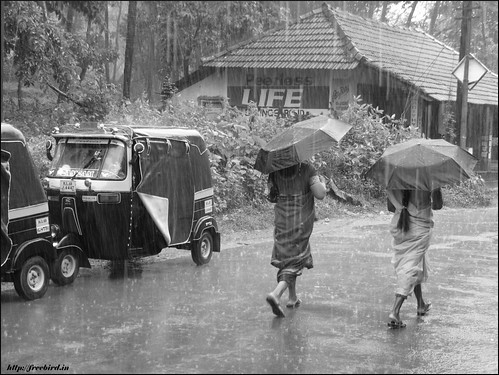
Flickr photo by freebird used under Creative Commons License
We were lucky enough to have a school within 5 minutes walking distance from home. But for many other children, some of whom had to walk upto 5 - 8 miles, it must have been the dreadful season balancing their books, lunch boxes and an umbrella, mostly through paddy fields with knee deep water. By the time they reached school, they would be wet to their skins and they had to spend the whole day with their wet clothes on. They had only an ottayadi patha or a narrow trail dividing two fields, made of mud to walk between the paddy fields. Many times if there was a breach in the mud trail and it was flooded with water, you just slipped and fell in it. Books got washed away, lunch boxes got washed away and still they would reach school with umbrellas in hand. It is quite a sight to behold little children leaving for school with their best dresses and umbrellas in hand. When we were children we had umbrellas made of palm leaves with a long bamboo handle which was known as olakuda or pattakuda. There were big ones and small ones and they were not foldable. This meant we needed lot of space to keep them when we reached school. Mothers wrote their childrens’ names inside the umbrellas so that they wouldn’t get mixed up. The olakuda had a large span and it fully protected us from the rains. The farm laborers used a modified version of this olakuda, which was much larger and conical in shape and had a cap like ring inside the umbrella which would sit on their head, thus holding the umbrella as they worked with both their hands.
After coming to Bangalore, we still had rains in the earlier years, but the charm was not there. You could not get wet in the Bangalore rains as the moment the rain falls it would become chill. We had rains throughout the year. Now Bangalore does not get much rains and I yearn for the Monsoon Magic of God’s own Kerala.
Sunday, June 29, 2008
Ayilyam and Moolam (redux)
There have been many desperate questions asked here regarding the ill effects of Moolam and Ayilyam. At the very outset, let me clarify that my inspriation for writing that blog post was only a phone call from a distressed father whose daughter’s birthstar was Moolam. It reminded me of the various sayings about various birth stars. They are all based on the customs being followed by the society at large. Other than that, I have not done any astrological or vedic research to find the truth behind these sayings.
As such, as I have written many people simply follow the custom, thinking that if so many people follow it, there must be something in it. At the same time, I have also heard from people who run to the astrologer for every small disturbance in their life that they don’t believe in the saying that girls born with Moolam and Ayilyam stars bring ill luck to the husband’s parents. I have also come across situations where the marriage of the boy has been delayed for long period because his birthstar is moolam or ayilyam, though the saying goes, “Aan moolam arasalum” (the man with bithstar moolam will rule the country).
All these beliefs came into existence when the marriages were fixed solely by the elders of the family and the groom and bride just tied the knots as per the elders’ wishes. They had no say whatsoever in the selection of their partners. The elders made sure that they selected the groom or bride as per their beliefs. There was no question of selecting a bride or groom if they thought the birthstars or horoscopes did not match. Many a time, the father or mother of the groom (when the other parent was not alive) came forward voluntarily to accept a girl with moolam or ayilyam, to the relief of the girl’s parents.
In today’s world, when most of the girls and boys select their partners, it is not possible to observe such customs. No girl or boy is going to find out about the other’s birth star when they start seeing each other. It would perhaps be prudent for the girls and boys to give enough importance to such matters, if they know about their parents’ views on these. It may save them from a lot of disappointment and distress, if they still want to get married with the blessings of their parents. Or else they should be brave enough to shoulder the responsibility of their decision. After all, as I have said, Moolam and Ayilyam are not considered to bring bad luck among many other communities in our society.
In the olden days, the horoscopes were matched by learned astrologers alone, whereas today we see that everyone has something to say about horoscope matching and hence so many right or wrong dos and donts. No one wants to ignore any astrological advice, whether coming from an astrologer or a common man. They are so confused and do not want to take any chances. I have even heard people saying that only 3 or 4 stars will match with some particular star and so on. All these things have made selection of a good alliance even more difficult.
As such, as I have written many people simply follow the custom, thinking that if so many people follow it, there must be something in it. At the same time, I have also heard from people who run to the astrologer for every small disturbance in their life that they don’t believe in the saying that girls born with Moolam and Ayilyam stars bring ill luck to the husband’s parents. I have also come across situations where the marriage of the boy has been delayed for long period because his birthstar is moolam or ayilyam, though the saying goes, “Aan moolam arasalum” (the man with bithstar moolam will rule the country).
All these beliefs came into existence when the marriages were fixed solely by the elders of the family and the groom and bride just tied the knots as per the elders’ wishes. They had no say whatsoever in the selection of their partners. The elders made sure that they selected the groom or bride as per their beliefs. There was no question of selecting a bride or groom if they thought the birthstars or horoscopes did not match. Many a time, the father or mother of the groom (when the other parent was not alive) came forward voluntarily to accept a girl with moolam or ayilyam, to the relief of the girl’s parents.
In today’s world, when most of the girls and boys select their partners, it is not possible to observe such customs. No girl or boy is going to find out about the other’s birth star when they start seeing each other. It would perhaps be prudent for the girls and boys to give enough importance to such matters, if they know about their parents’ views on these. It may save them from a lot of disappointment and distress, if they still want to get married with the blessings of their parents. Or else they should be brave enough to shoulder the responsibility of their decision. After all, as I have said, Moolam and Ayilyam are not considered to bring bad luck among many other communities in our society.
In the olden days, the horoscopes were matched by learned astrologers alone, whereas today we see that everyone has something to say about horoscope matching and hence so many right or wrong dos and donts. No one wants to ignore any astrological advice, whether coming from an astrologer or a common man. They are so confused and do not want to take any chances. I have even heard people saying that only 3 or 4 stars will match with some particular star and so on. All these things have made selection of a good alliance even more difficult.
Saturday, June 21, 2008
Elsewhere In The Empire
The Blandings Media Empire never sleeps. While I'm taking a break from blogging here, I've put up a new post on my stories blog. The story of two cats and a monkey and sharing everything alike is up on Kathai Kathaiyam Karanamam. Meanwhile, my handsome and charming son continues to chronicle his discoveries in India: Interesting advertisements on TV, the new Bangalore airport (messes and all), and much much more. He seems to be much more prolific than I.
Friday, June 06, 2008
Recipe: Aavakkaya

Aavakkaya is the pickle synonymous with Andhra Pradesh. The utterance of the word “Aavakkai” tickles the taste buds. And when you make it, you cannot but help your mouth watering. The aroma of the newly made pickle is so intoxicating. Aavakkaya literally means pickled with mustard powder (aavalu in Telugu means mustard) and rightly so, mustard powder is the main preservative here along with gingelly oil.
When one of my son’s assistants brought home a basket full of mangoes, I was at a loss not knowing what to do with so many raw mangoes. I asked him why he brought so many mangoes when I would have been happy with 2 or 3. “Pickle them, Mummyji,” he said. That’s when I thought of making Aavakkaya. As I had not made this pickle in recent times, I called my friend Sujatha, to ask for the method. She promptly said, “I will come tomorrow and help you. Keep chilli powder, salt, mustard powder and oil and other things ready.” I was only too happy to get the things ready, as I did not have to worry about the final product. I have been getting to taste Sujatha’s mother’s Aavakkaya every year. And they are superb.
She specifically told me not to buy the mustard powder, but to buy mustard, sun dry and grind them fresh. "Or else," she said, "the pickle will taste bitter." So I went and bought all the ingredients and sun dried them . I also washed all the mangoes thoroughly and dried them in shade, by spreading them in a clean towel, to remove all moisture.
Sujatha came promptly at 11 am next morning and we started the preparation.We cut the mangoes into large pieces and measured them. Accordingly we measured the other ingredients. Here is the ratio:
Ingredients:
Raw mango pieces: 5 measures ( approximately 3.5 Kg)
Red chilli powder : 1measure (I used 300gms. One may add upto 500gms., depending on individual preference)
Freshly ground mustard powder: 1 measure ( here again those who like the taste of mustard oil can use upto 500 gms )
Salt: 1 ¼ measure(8oogms)
Whole fenugreek seeds: 50 gms
Turmeric powder: 2 tbsp.
Good quality gingelly oil: 1 ltr
Method:
The mangoes should have firm stone inside.(the stone should be attached to the flesh of the mango and when cut through, the stone should still be attached to the mango pieces.) Wash and dry the mangoes in a clean towel in shade. Cut them into large pieces.Discard the soft seed portion .
Keep the other ingredients ready(in the proportion given above).

Keep a large glass jar or earthenware jar washed and sun-dried, ready. (As I was in Hyderabad, where I function with minimum kitchen gadgets, I did not have a glass jar or earthenware jar. Hence I used a large pet jar).
Now comes the most difficult part. Mixing the ingredients. Sujatha insisted on mixing them with hands. I would have preferred mixing them with a large spatula, as my skin is very sensitive to chilli powder.

Mix all the dry ingredients(chilli powder, mustard powder, salt,turmeric powder and fenugreek seeds) thoroughly. Take another large shallow pan for the final mixing. Into this pan, transfer a portion of the cut mango pieces. Add a portion of the pickle masala to the mangoes. Pour 1 or 2 spoonfuls of gingelly oil and mix the contents thoroughly with hand or a spatula. Transfer them to the jar. Repeat this process, until all the mango pieces and pickle masala are used up. Top the jar with the remaining oil and pickle masala, if any. Keep the jar in a cool dry place. Within an hour, you can see the gravy oozing out of the mango pieces and within 2 to 3 hours, there would be a 1”top layer of oil and gravy above the mango pieces(called “Oota” in telugu). This is the sign of right quantity of ingredients, said, Sujatha’s mother, when I called her to report the event. Stir it thoroughly with a dry spoon every day for 5 days, she said. I followed her instructions and the results were just superb.

Subscribe to:
Posts (Atom)