Showing posts with label vishu. Show all posts

Thursday, April 15, 2010

Happy Vishu 2010


Wishing all my readers a happy vishu. May the new year bring you prosperity and happiness.

Saturday, June 27, 2009

Recipe: Manga Kootan


Raw mangoes are used for preparing tasty gravy dishes to be mixed with rice. The raw mangoes provide the tanginess which is a must for any south Indian gravy dish. The Malayalam saying goes, ”Aaru maasam marapuli, aaru maasam manga puli,” which means for 6 months in a year one uses tamarind and the remaining 6 months one uses the tangy mangoes. This dish can be prepared with tangy raw mangoes and also with just ripening (a little sweetish) mangoes. This is an important dish on Vishu day as the Vellarikkaya from the Vishukani is used in making this dish. Though I have mentioned this dish many times in my blog I have not given the recipe yet. Here we go.

Ingredients:
Raw Mango: 1 (Big)
Drum sticks: 2
Kani Vellarikaya or Ash gourd : 200gms.
Sour curds: ½ cup
Coconut: 1 cup
Green chillies: 3
Red chillies: 3
Methi seeds 1 tsp.
Turmeric powder: 1 tsp.
Jaggery: a small piece
Salt to taste
Oil 2 tsp.
Mustard seeds: 1 tsp.
Curry leaves: a few sprigs.

Method
Heat ½ tsp of oil. Add ½ tsp of methi seeds and 2 red chillies cut into pieces. When the methi seeds turn reddish, remove from heat. Cool and grind with coconut and green chillies. Use beaten curds to grind the coconut to a smooth paste. Keep aside.

Cut the mango into big chunks. Cut the ash gourd into 1” squares. Cut the drum stick into 2” pieces. Cook the vegetables in enough water with turmeric powder and salt. When the vegetables are cooked add a small piece of jaggery (This will balance the tanginess of the mangoes). Mix the ground paste in the remaining curds and add to the cooked vegetables and boil. Remove from heat. Add a few curry leaves.

Heat the remaining oil in a kadhai. When the oil is hot, add the mustard seeds, remaining methi seeds and 1 red chilli cut into small bits. When the mustard crackles, add the curry leaves and pour the tempering into the manga koottan.

nJoy!

Wednesday, April 29, 2009

Vishu Ramblings

I had a whirlwind trip to Bangalore over Vishu and as has been happening ever since I started spending more time in Hyderabad, this trip was also very hectic with too much fitted into each day. At the end I was able to finish most of the errands, chores and visits on my schedule and shelved the rest for the next time. More importantly, I was able to meet some old friends (literally) who were living alone and who were really pleased to meet me. I cannot forget what Mrs. Thomas told me when she saw me at her door.”Nobody visits me anymore and hence I was surprised to hear the door bell ringing. I just spend my days all alone moving from one room to another. I am not able to do any cooking also. I get everything from outside” she said. I was glad I made it to meet her.

What was special for Vishu? Well, we had the Kani. For the first time in all these years, I did not cook a Vishu lunch. My brother had invited us for lunch at his place along with my other siblings as he was turning 50 on that day. So I prepared Paladai Pradhaman (Recipe soon) and took it along. We had a sumptuous lunch of Manga Koottan, Erissery, Thoran, Koottu, Pappadam and a simply yummy Palpayasam. I enjoy these rare occasions when I get to eat a lunch I have not cooked. The reason – very simple - As I have not been inhaling the flavor of the various dishes being prepared at the preparation stage, my palate is still fresh to devour the dishes being served and believe me, they taste superb. Especially so when the food is cooked by my mother. In my brother’s house, the lunch was prepared by my mother and my sisters-in-law, who all follow my mother’s method of preparation.

On my return to Hyderabad I had to attend the engagement ceremony of my nephew where I got to meet many of my cousins whom I had not met for a long time. The engagement ceremony or Nischayathamboolam in tambram lingua was a small affair in the olden days. It was only a small function attended by the elders from the bride’s and groom’s family in the presence of village elders. The function was usually conducted in the groom’s house and the bride did not attend this function. The bride went to the groom’s house only after the marriage. The bride and groom had no part to play in the function. This was called vangnischayam or oral commitment by exchanging thamboolam (fruits, mostly the yellow plantain fruit, coconuts, betel leaves and nuts) and was like an assurance by both the families to go on with the other preparations for the marriage. The actual Nischayathamboolam (vedic ritual) is performed on the eve of marriage. These days of course the nischayathamboolam itself is performed in a grand manner with both the bride and groom present in the function with exchange of rings and gifts and followed by a grand dinner or lunch.

In the olden days, once the vangnischayam was over there was no deviation from the promises made by both the parents unless there was a major problem. These days cancellation of engagements is very common. While we were at the function there were stories of cancelled engagements which could have been avoided and the innocent party spared the pain of ignominy associated with it. It would be better for the youngsters to come clean with their parents at the time of agreeing for marriages (even today most marriages are arranged by parents) and to keep up their promise after giving their consent. How does one explain the incidence when the groom withdraws his consent for the marriage the morning after engagement or the bride calling up the groom and saying “I have no intention of living with you after marriage and have agreed with my parents only because of their threat,” and so on? The parents as well as the groom and bride should be very frank when it comes to marriage as it involves another family and set of people who are no party to the other people’s hang-ups and reservations. The parents would do well to have a one to one talk with their children and get their whole hearted consent before agreeing to a marriage with a person of their parents’ choice. The youngsters also should be able to convince their parents of their approval or disapproval of the bride or groom of their parents’ choice and should be bold enough to stand up to their decision so that nobody would get hurt. I really wish parents and children do not put any pressure on each other when it comes to marriage. We'll all be better for it.

Tuesday, April 14, 2009

Happy Vishu 2009


A very happy vishu to all my readers. I wish you all a happy and prosperous new year. May the new year bring much joy to all of you.

Friday, April 03, 2009

Important Festivals in April 2009

3rd April 2009 - Sreerama Navami
Sreeramanavami is celebrated as Lord Rama’s birthday. Special poojas are conducted in temples and also at various venues. At home we celebrate Sreeramanavami by preparing vella avil (sweet poha), vadai and panakam and offered as neyvedyam. Many people prepare payasam also.

8th April 2009 - Pankuni Uthiram
In the month of Pankuni, the full moon day coincides with the day of the star Uthiram and is celebrated as Pankuni Uthiram. Pankuni Uthiram is celebrated as the day Lord Muruga wedded Devayani and hence is an important festival in all Muruga temples. It is also believed to be the day of Lord Shiva’s wedding with Parvathy and Lord Ranganatha’s wedding with Ranganayaki Thayar and Lord Srirama’s wedding with Sita. It also celebrated as Lord Ayyappa’s birthday in Sabarimala. Special poojas are conducted in the temples. At home it is observed by offering Panakam and Sweet Payar to Lord Muruga and partaking the prasadam.

14th April 2009 – Vishu
Vishu is the New Year day for people of Kerala and also Tamil Nadu. The important ritual on Vishu day is the seeing of Vishukani on the morning of Vishu followed by the eldest member of the family giving Kaineettams (gifts of money) to all the younger members of family. Then of course follows the special vishu lunch.

27th April - Akshaya Thrithiya
Akshaya Thrithiya falls on the third day of the bright half of Vaishakh month (April-May).The word akshaya means eternal or that which never diminishes and hence it is believed that any project initiated on this day will reach great heights. Akshaya Thrithiya is celebrated in the famous Guruvayoor temple in Kerala as the birthday of Lord Balarama. It is believed to be the day when Lord Krishna bestowed wealth and prosperity on his childhood friend, Kuchela(Sudhama) who went to meet him with a packet of avil (poha). Many people symbolically buy something new on this day. More recently, there is a new craze among people to buy gold on this day so that they will be able to buy more gold in the coming days of the year which is being fully exploited by the jewellers.

Monday, June 11, 2007

Grihapravesham (I)


For sometime now, we had been planning to move to a smaller city/smaller place, just to get out of this maddening crowd in Bangalore. The roads have become very crowded, the vehicular traffic has increased to such an extent that walking on the roads is next to impossible. The haphazard parking of cars and motor cycles makes it difficult to get out of the houses or even enter people’s houses when you go visiting. The problem worsens if it rains.

We had always wanted to go back to a quiet and leisurely village in Kerala surrounded by greeneries and flowing water. Running water has been a weakness for me for so long. I would give anything to be able to take a swim in clear and unpolluted water. It has remained an unfulfilled dream so far. Somehow, moving to Kerala was not happening due to various factors. So when my brother suggested about an apartment a little away from the crowd, our handsome and charming son decided to buy it so that we could move in there and have a quieter life. The added incentive was that all my brothers were also buying an apartment each there, although none of them had plans to move in there at the moment.

The apartment house was ready for occupation from the builder’s point and people had already occupied. We wanted to make some minor modifications/additions here and there and also get the interiors done. We were promised everything would be done in 2 weeks time and we could occupy it by 1st week of March. We gave a month’s extra time and decided to conduct the grihapravesham after Vishu, so that our son could also get some vacation.We made trips to the new apartment almost everyday and though the interiors were ready by end of March, the additional masonry work had not even started. With lots of coaxing and cajoling we got some of the work done and decided to conduct the grihapravesham on the 23rd of April.

In the meantime, we started packing our things and also preparing for the grihapravesham. We had arranged to conduct a Ganapathi Homam, Vasthu Homam and Navagraha Homam and host lunch for a few of the near and dear.

We had to buy a whole lot of things and transport them to the new place, 6 kms away. The weather was scorching and humid..To reach this new place either we had to take an autorikshaw who would oblige at his will and ask for that extra 10 bucks or we had to walk upto 1½ kms if we decided to travel by bus. At times we walked almost 1 km to get a rikshaw. My memories went back 19 years when we had moved to our present house and did the grihapravesham in a much more elaborate manner. Things weren’t so difficult then, I remembered. We both were working full time and children were in school. When I said this to our handsome and charming younger son over phone, he said, “Patti was there amma.” True. My astute and blessed mother-in-law was around and she was a great manager and co-ordidnator. She was not at an age where she could get out and manage things but I could give her a list of things to be done by the various people and leave home in the morning for work and reach back late in the evening after visiting the construction site and every thing would be ready at home. Most importantly, all the four of us were mobile (on our own). We could finish many chores on our way up and down and didn’t have to depend on each other. Things were different now. Patti is no more with us and nor is any one mobile.

Couple of days to go for the function, my husband borrowed his friend’s car so that we could commute much more comfortably. Our son brought the car from the friend’s place. We all went to the apartment and stayed back longer to get the pending electrical work finished without any worry about reaching back home as we had a car. We came down at 7.30pm and found the car with a flat tyre. With great difficulty we got a mechanic to repair the flat tyre and we left the place around 8.30 pm. Hardly had we moved a kilometer and suddenly the car jerked and was going towards the electric post by the side of the road. We did not know what was happening and only our son’s presence of mind saved us from a major accident. He could somehow bring the car to the side of the narrow road and that was it. The car wouldn’t move, the steering wheel was not controlling the wheels as it had had come loose from its couplings. We were in the midst of a very busy road, hardly enough room for single lane traffic. We just couldn’t move the car. My husband phoned his friend, who just gave his mechanic’s phone number and said we could get in touch with the mechanic. It was futile even to imagine that the mechanic would be available at the garage at 9.30pm. My husband tried his luck with one of the workmen we had engaged to get some grill work done and it clicked. The nice man came with two of his boys and still we couldn’t move the care. Cars and buses were honking on all the four sides and I was sitting inside a hot and humid car. With nothing else to do, I just sat there and started reciting my Lalitha Sahasranamam per my daily schedule. Just then two boys came as if from nowhere and asked us what the problem was. They were car mechanics, they said and with great difficulty with the combined effort of all of us, we could push the car away from the road. The boys said, they would get their tools and see if something could be done. Meanwhile, our son insisted that we go home. With difficulty, we hired an auto and reached home at 10.00 pm. Later our son also reached home after having deposited the car under the care of the grill maker.

So the next day getting the car repaired was also on our shoulders. With luck, we could get the job done by evening after spending a handsome amount.

We had just 30 hours to go for the function.

Tuesday, May 08, 2007

Long timeout

It has been a long time since I posted, and it will be longer still before I get another chance to post. First we had Vishu, then we had to move our home, and now I'm off on to a family ceremony for my nephew's thread ceremony (pictures of Puthucode when I return!).

In the meanwhile if you folks can post comments about things you'd like me to write about, please do so, it will give me a good list to start off with when I get back.

Sunday, April 22, 2007

Vishu 2007


Another Vishu. What was special about this year’s Vishu was that our son was with us to celebrate Vishu.

Though Vishu is the new year day for Malayalees, Tamilians, people of the North eastern states of India and also the Punjabis, this year (as in many other years), all the other people except Malayalees, celebrated their new year day on the 14th and the Malayalees celebrated it on the 15th April. That was because the Mesha Sanakramam or the time at which the sun entered the Mesha rasi was at 11.40 am on the 14th. The Vishu Kani is seen on the morning after the Mesha Snakramam, Hence, though April 14th was 1st of Mesha masa, This year the Vishu Kani was seen on the 15th morning.

The year that was born on the 14th is named Sarvajith. There are 60 years starting with Prabhava according to Hindu Astrological science.

As usual, we had the Vishukani in the morning. From early morning on Vishu, I had a very bad throat and by breakfast time, it developed into very bad bronchitis and I was feeling so exhausted I had to drop the idea of making a grand feast with Chakka Pradhaman. I had been looking forward to this since our son was with us. But both the son and father insisted that I shouldn’t overstrain myself and we had a simple lunch of Manga Koottan, Kootu and Palpayasam instead.

While almost all the other Indian states celebrate Diwali with crackers, Kerala has crackers during Vishu. Cracker shops would sprout even in the remotest of villages a couple of days before Vishu. Usually schools start their summer vacation from the 1st of April and hence children are at their leisure.

When we were growing up we could buy a big bag of crackers for just Re 1. A day prior to Vishu, Kalathappa (our grandfather) would give us 4 annas (25 paise) each to buy crackers. We would emotionally blackmail Echiyamma (our grandmother) to part with another 4 annas and the three of us (my sister, my cousin and I) would have in total Rs 1.50. This firmly in hand, we would march to the market. Before we left, Kalathappa would say, “don’t forget the “malapadakkam” for the kandam. This meant, ½ anna would go for that. Anyway, we would come back with a bag full of colormatches and sparklers and flowerpots and very few bursting crackers. Back home, we would divide our shopping and dry them in the sun separately. On vishu morning, after seeing the Kani, we would start bursting our crackers. On vishu morning, we would again be richer by Rs0.50, got as Kaineettam from Kalathappa and Echiyamma. So we would do one more round of the market to get some more crackers for the evening.

Tuesday, April 18, 2006

Happy Vishu


We celebrated "Vishu" on the 14th April. Vishu or Mesha Vishu as it known is the New Year's Day for Malayalis (this is the new year day as per the Solar calendar followed for all calculations pertaining to fixing dates of rituals, festivals, seasons and weather predictions as well as Panchanga preparations though 1st day of the Malayalam month Chingam is taken as the new year day for the Malayalam Era) and also for Tamilians. The southern most states and also the north-eastern states and north western states celebrate 14th April as their new year's day. In the states of Karnataka, Andhra Pradesh and Maharashtra, New Year's Day is celebrated a few days prior to this. They observe Chandramana Ugadi (The day following the New Moon day) or lunar New Year. Mesha Vishu is Souramana Ugadi or solar New Year.

In the north eastern states also, it is called Bihu, where as in the other northern states, it is known as Baishakhi. April 14th is the day the sun enters the Aries (Mesha) sign beginning the movement towards northern hemisphere marking the beginning of hot days.

In Kerala, the day marks the beginning of the agricultural season. They would have had one or two pre monsoon showers and the land would prepared for sowing. Farmers start sowing on that day after Vishukani. It is the most auspicious day for commencing agricultural activities for the new season.

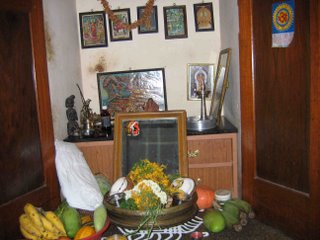
Vishukani is the most important ritual on "Vishu" day. Kani means the first sight you see in the morning. There is a popular belief that the first sight you see on any morning decides the happenings of that day. Accordingly, people always like to see a good kani everyday. So the kani on Vishu day becomes all the more important because, the kani you see on Vishu day is believed to be the indicator for the life during the year to follow. People make sure that the kani that they see on Vishu is one of prosperity and well being and packed with all good things in life. The colour yellow is considered auspicious and has a special place in all Hindu Rituals.

Preparations for the Vishukani are started the previous evening. The place for Vishukani, usually the  pooja room, is readied by cleaning and decorating with a rangoli made of rice flour. The kani things are kept in a wide mouthed bronze utensil, known as Uruli. Raw rice is spread inside the uruli and on top of the rice is kept the all important vegetable of the kani, the golden kanivellarikka. (It is a type of gourd which turns golden yellow with streaks when ripe). On top of the Vellarikka comes another very important item of the Kani, the golden kanikonna flowers (Cassia Fistula). This is the season for the kanikonna flowers and the landscape is filled with trees bearing the drooping golden flowers. The very important Keralas's own coconut is cut into two equal halves and kept on either side of the kanivellarikka. Gold and silver coins are kept inside each half of the coconut. Betel leaves, betel nuts, a white dhothi, and all types of seasonal fruits and vegetables are kept in and around the uruli. Kumkum and turmeric pieces symbolising prosperity and auspiciousness and well being is also kept. This is the season when mangoes and jackfruits are aplenty in Kerala and all types of gourds like, ash gourd, pumpkin, and snake gourd are all available. A mirror is kept at the head side of the uruli so as to reflect all the kani things. A lamp with oil and wick is kept ready to be lighted in the morning. This done, the whole thing is covered with another bigger utensil or a white cloth.

On Vishu day, the head of the family, the oldest male member who is the "karanavar" and the lady of the house wake up early in the morning (when we were children our grandma used to wake up at 3 am). The lady lights the lamp and after seeing the kani, the karanavar sits near the kani ready with his bag of coins. Then the lady of the house wakes up each member of the family and leads them towards the kani with their eyes closed. They are to open their eyes only in front of the kani, so that the first thing they see on vishu morning would be one of prosperity and abundance. After prostrating to the Gods each member prostrates before the Karanavar and each one is gifted with a cash award, symbolising plentiful in the days to come. In Kerala, people crack firecrackers on Vishu morning. All visitors to the house on Vishu day are awarded with a cash prize. Normally every temple in Kerala will also keep Kani and people after the Kani in their home, take bath and go to the temple to see the Kani there and for prayers. Of course, the pujari will not be in a position to give cash gifts to all , but the God/Goddess will give them plenty during the days that follow throughout the year.

After all members of the family have seen the kani, the uruli with kanithings are taken to the manger for the cows to see the kani. Keralaites considered cow as their family member and wanted the year to be one of well being for the cows as well.

The Vishu day is as usual a feasting day with a sumptuous lunch.